Product · Electromagnetic
Leonidas
Solid-state high-power microwave counter-drone system; Gen II ordered by the Army as IFPC-HPM.
by Epirus
- Milestones3
- Sources6
- Operators1
- Components—
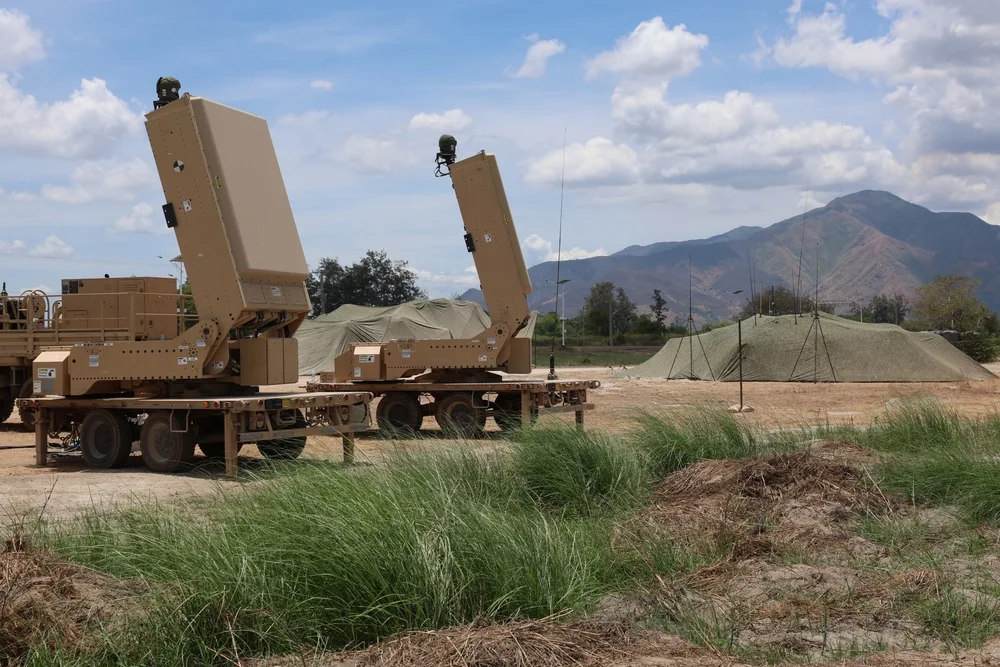
Photo: U.S. Army photo by Staff Sgt. Brandon Rickert · Public domain (PD-USGov-Military-Army) · U.S. Army IFPC-HPM variant of Epirus Leonidas; exact program identity corroborated by the Army Balikatan2025 article and Epirus program announcement.
Solid-state high-power microwave counter-drone system; Gen II ordered by the Army as IFPC-HPM.
Timeline3
- First deliveryConfirmed
First Leonidas-derived IFPC-HPM prototype delivered to the Army
Epirus announced on 1 November 2023 that it had delivered the first of four IFPC-HPM prototypes after government acceptance testing in Nevada; the exact delivery day is not stated.
Program: Indirect Fire Protection Capability High-Power Microwave
SourcesEpirus (PR Newswire)
- MilestoneConfirmed
Defeats 61 of 61 drones, including a 49-drone swarm, at Camp Atterbury demonstration
Invitation-only live-fire demonstration in Indiana across five flight scenarios, ending with a 49-drone swarm disabled by a single pulse.
SourcesEpirus
- MilestoneReported
Second-generation Leonidas completes Army testing
An Epirus executive said the second-generation system completed testing with the Army in February 2026 and that the Army owns two of them.
SourcesBreaking Defense
Solid entries are confirmed, outlined reported, dashed estimated or still to come; dotted italic entries are speculative. Dates show only the precision the sources give.
Technologies1
Supply chain inputs1
- Lithium-ion battery cells
Component
China produced 80% of global battery cells and over 90% of anode material in 2024 (IEA). CATL and other Chinese battery makers are on DoD's 1260H list, and China's October 2025 controls on high-energy-density cells (suspended to November 2026) target the cells drones use.
HighReported
Materials, components and capacity this product depends on. Open an input to see who produces it and the controls on it.
Cost to the government
- Contract unit priceEstimated$21.8M2 units
Army RCCTO contract (Jul 2025): $43,551,060 base for two IFPC-HPM Gen II (Leonidas) systems plus associated test events, support equipment and spares; $43,551,060 / 2 = $21,775,530 per system (division by us; overstates the hardware price because test events and spares are included).
Unit costs and contract unit prices for this product, and budget figures for the programs that buy it. Each figure states its dollar basis and links its source; contract values are under Programs & awards.
Operators1
- USUnited States
News3
Sources6
- 1.
Sam Eckholm · Mar 28, 2026 · Supports: System · name
“Leonidas”
- 2.
Epirus · Sep 10, 2025 · Supports: System milestone
“Epirus announced today the results of an August 26 demonstration of the company’s Leonidas high-power microwave (HPM) system”
- 3.
Epirus · Jul 17, 2025 · Supports: Cost · amount
“Epirus announced today a $43,551,060 contract from the U.S. Army's Rapid Capabilities and Critical Technologies Office (RCCTO). The base contract includes delivery of two Integrated Fires Protection Capability High-Power Microwave (IFPC-HPM) Generation II (GEN II) systems”
- 4.
The War Zone · Jul 17, 2025 · Supports: System, System · system input:lithium-ion-cells
“They also benefit from user feedback from the deployment of four GEN I system prototypes to the Middle East in 2024 and to the Indo-Pacific earlier this Spring.”
- 5.
Epirus (PR Newswire) · Nov 1, 2023 · Supports: System milestone
“Epirus announced today the delivery of the first Indirect Fire Protection Capability – High-Power Microwave (IFPC-HPM) system to the U.S. Army.”
- 6.
Breaking Defense · Supports: System milestone
“The second generation recently completed testing in February with the Army, and the service owns two of those systems, he said.”
Each fact on this page is attached to the sources that support it. Archived copies are linked when we keep one.