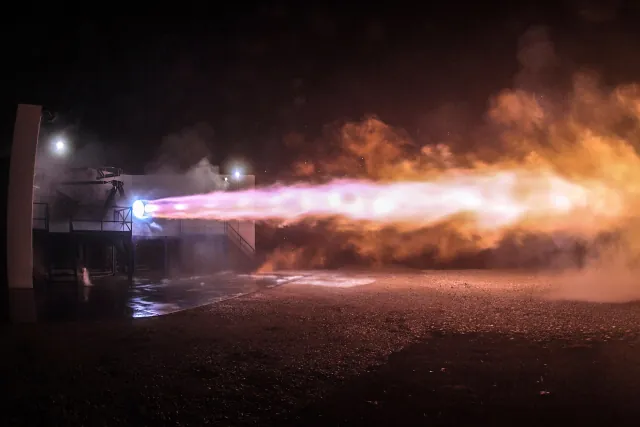
Raptor
PrototypeEngine
Raptor propulsion family powers both Starship stages; engine counts vary by vehicle generation.
Link Confirmed
Launch vehicle · Space
Reusable transportation system combining the Starship upper stage and Super Heavy booster.
by SpaceX
Photo: Photo by Steve Jurvetson via Wikimedia Commons · CC BY 2.0 · Resized and re-encoded as WebP from the original.
NASA selects Starship lunar lander for Artemis
NASA selected SpaceX for a $2.89 billion contract to develop and demonstrate the HLS Starship lunar lander. This concerns the lunar lander variant, not a completed lunar landing.
SourcesNASA
First integrated Starship and Super Heavy flight
The complete two-stage system first flew on this date. Earlier Starhopper and upper-stage prototype flights are separate tests.
SourcesSpaceX
Flight 2 reaches space after hot-stage separation
The second integrated flight achieved stage separation and reached space. The booster broke apart and the upper stage was destroyed before completing its ascent burn.
SourcesSpaceX
Flight 3 completes ascent burn and attempts reentry
The upper stage completed its ascent burn and began a propellant-transfer demonstration. Both vehicles were lost; the planned in-space engine relight was not attempted.
SourcesSpaceX
Flight 4 achieves controlled splashdowns
Super Heavy completed a soft splashdown off Texas, and Starship survived reentry and landed in the Indian Ocean. This was a test flight, not an orbital payload mission.
SourcesSpaceX
Flight 5 achieves first Super Heavy tower catch
The launch tower caught Super Heavy on the first catch attempt. Starship completed controlled reentry and splashed down in the Indian Ocean.
SourcesSpaceX
Flight 6 demonstrates an in-space Raptor relight
Starship relit a Raptor in space and subsequently splashed down. The booster catch was aborted following tower health checks, and Super Heavy diverted to a soft splashdown.
SourcesSpaceX
Flight 7 catches booster but loses upgraded upper stage
The redesigned Starship upper stage was lost before completing ascent. Super Heavy returned for the program’s second successful tower catch.
SourcesSpaceX
Flight 8 catches booster but loses upper stage
Super Heavy was caught for the third time. Starship lost engines and attitude control during ascent, with final contact about nine and a half minutes after launch.
SourcesSpaceX
Flight 9 first reuses a Super Heavy booster
The reused booster completed ascent but was lost during its landing burn. Starship reached its coast phase, but failed to deploy its simulator payloads and was lost before controlled reentry.
SourcesSpaceX
Flight 10 demonstrates payload deployment and splashdowns
Starship released eight Starlink simulators on a suborbital trajectory and relit a Raptor in space. Both vehicles completed their planned water landings.
SourcesSpaceX
Flight 11 concludes second-generation Starship campaign
The final flight of second-generation Starship deployed eight simulators, relit a Raptor in space and completed a soft splashdown. Super Heavy also splashed down.
SourcesSpaceX
Flight 12 introduces V3 vehicles and Raptor 3
The first V3 flight launched from Pad 2, deploying simulators and two modified satellites on a suborbital trajectory. Super Heavy had a hard splashdown, while Starship completed reentry and splashdown.
SourcesSpaceX
Flight 13 deploys Starlink V3 satellites on a test trajectory
Twenty Starlink V3 satellites were deployed on a trajectory expected to reenter shortly afterward. Starship completed a soft splashdown; Super Heavy experienced a hard splashdown.
SourcesSpaceX
Flight 14 achieves first orbit and orbital payload delivery
Starship entered orbit and deployed 26 Starlink V3 satellites. After shortening its orbital coast because of an ascent engine issue, it deorbited and splashed down in the northern Pacific.
SourcesSpaceX
Solid entries are confirmed, outlined reported, dashed estimated or still to come; dotted italic entries are speculative. Dates show only the precision the sources give.
Raptor propulsion family powers both Starship stages; engine counts vary by vehicle generation.
Link Confirmed
SpaceX · May 26, 2023 · Supports: System milestone
“On April 20, 2023 at 8:33 a.m. CT, Starship successfully lifted off”
Federal Aviation Administration · Supports: System
“The Raptor engine is powered by liquid oxygen and liquid methane.”
NASA · Supports: System · system component:raptor
“Starship, using six Raptor engines, separated from the Super Heavy booster”
NASA · Supports: System milestone
“The firm-fixed price, milestone-based contract total award value is $2.89 billion.”
SpaceX · Supports: System milestone
“eight Starlink simulators deployed in the first successful payload demonstration from Starship”
SpaceX · Supports: System milestone
“This was the final flight of the second-generation Starship and first generation Super Heavy booster”
SpaceX · Supports: System milestone
“This was the first flight of the Starship and Super Heavy V3 vehicles”
SpaceX · Supports: System milestone
“Starship then successfully deployed all 20 Starlink V3 satellites”
SpaceX · Supports: System milestone
“Starship executed a successful hot-stage separation”
SpaceX · Supports: System milestone
“becoming the first Starship to complete its full-duration ascent burn”
SpaceX · Supports: System milestone
“was caught by the chopstick arms of the launch and catch tower at Starbase”
SpaceX · Supports: System milestone
“The ship successfully reignited a single Raptor engine while in space”
SpaceX · Supports: System milestone
“resulting in the second successful catch of a Super Heavy booster”
SpaceX · Supports: System milestone
“resulting in the third successful catch of a Super Heavy booster”
SpaceX · Supports: System milestone
“The Super Heavy booster supporting the mission made the first ever reflight in the Starship program”
Each fact on this page is attached to the sources that support it. Archived copies are linked when we keep one.