
Blog
American Defense Manufacturing: Mapping Companies, Capabilities, and Capacity
How to judge U.S. defense production by facilities, capabilities and suppliersPublished · Updated · By DefDex
On this page 13
- Short answer
- What American Defense Manufacturing Actually Means
- How to Build a Defensible List of American Defense Manufacturing Companies
- The U.S. Defense Industrial Base, Mapped by Capability
- Prime Contractors Versus Lower-Tier Defense Suppliers
- Why Contract Value Is Not Manufacturing Capacity
- Where Defense Manufacturing Happens in America
- Defense Startups, Funding and the Path to Scaled Production
- Policy, Onshoring and Hidden Supply-Chain Exposure
- Research American Defense Manufacturing with DefDex
- Map the American Defense Industrial Base
- Related guides
- FAQ
Short answer
How can you tell whether a defense company really manufactures in the United States?
Search “American defense manufacturing” and results often point to American Defense MFG, a U.S. firearms brand selling rifles, optic mounts, and accessories. This guide addresses the broader defense industrial base. We evaluate domestic manufacturing through facilities, production capabilities, contracts, ownership, and supply-chain origin. A U.S. headquarters or large contract does not, by itself, prove domestic production capacity.
Key takeaways
- A corporate address shows where a business is registered or managed, not where components are machined, electronics are fabricated or systems are assembled.
- An announced contract value may be a maximum ceiling rather than obligated funding, and options or future task orders are not secured production revenue.
- Useful capacity signals include capital-equipment purchases, installed production lines, added shifts and accepted deliveries, and the strongest cases pair physical investment with sustained deliveries.
- Domestic final assembly does not secure the supply chain, because a U.S. factory may still rely on foreign chips, minerals, chemicals, machine tools or specialist suppliers.
What American Defense Manufacturing Actually Means
This guide examines the national manufacturing base, not American Defense MFG, the similarly named firearms and accessories company that appears prominently in search results. The broader market includes the companies, facilities, workers, suppliers, materials, and equipment used to produce defense systems and components in the United States.
We assess domestic manufacturing across five dimensions:
- U.S. facilities
- Ownership or control of production
- Relevant manufacturing capabilities
- Defense contract and program history
- Origin of critical inputs
Headquarters Are Not Manufacturing Evidence
A corporate address shows where a business is registered or managed. It does not reveal where components are machined, electronics are fabricated, systems are assembled, or production risks sit.
Even U.S. final assembly may depend on foreign materials, chips, chemicals, machine tools, or subcomponents. We therefore follow production below the corporate level.
Why the Search Results Miss the Market
Search results often interpret the term as a query about American Defense MFG products, including rifles, mounts, and accessories. That does not answer the industrial question.
Analysts, investors, and business development teams need to know which companies manufacture specific products, at which facilities, for which programs, and with what evidence of capacity.
How to Build a Defensible List of American Defense Manufacturing Companies
A credible manufacturer list needs consistent inclusion rules. We look for active U.S. defense production or a documented and operationally credible route to production.
Distributors, resellers, and engineering consultancies should not be classified as manufacturers without evidence of production. Each record should connect the company to its facilities, capabilities, products, programs, contracts, ownership, and funding.
Minimum Inclusion Criteria
We recommend documenting:
- A U.S. facility and its manufacturing activity
- Evidence of defense relevance
- Current ownership and operating status
- The date and source of the evidence
- Whether production is active, planned, outsourced, or at prototype stage
Fresh evidence matters because facilities close, programs change, and announced factories may never begin production.
Useful Company Segments
We separate established primes, subsystem integrators, lower-tier suppliers, venture-backed manufacturers, dual-use industrial companies, and private-equity-owned platforms.
Prototype-stage companies should be identified clearly. A successful demonstration does not prove repeatable, quality-controlled production.
The U.S. Defense Industrial Base, Mapped by Capability
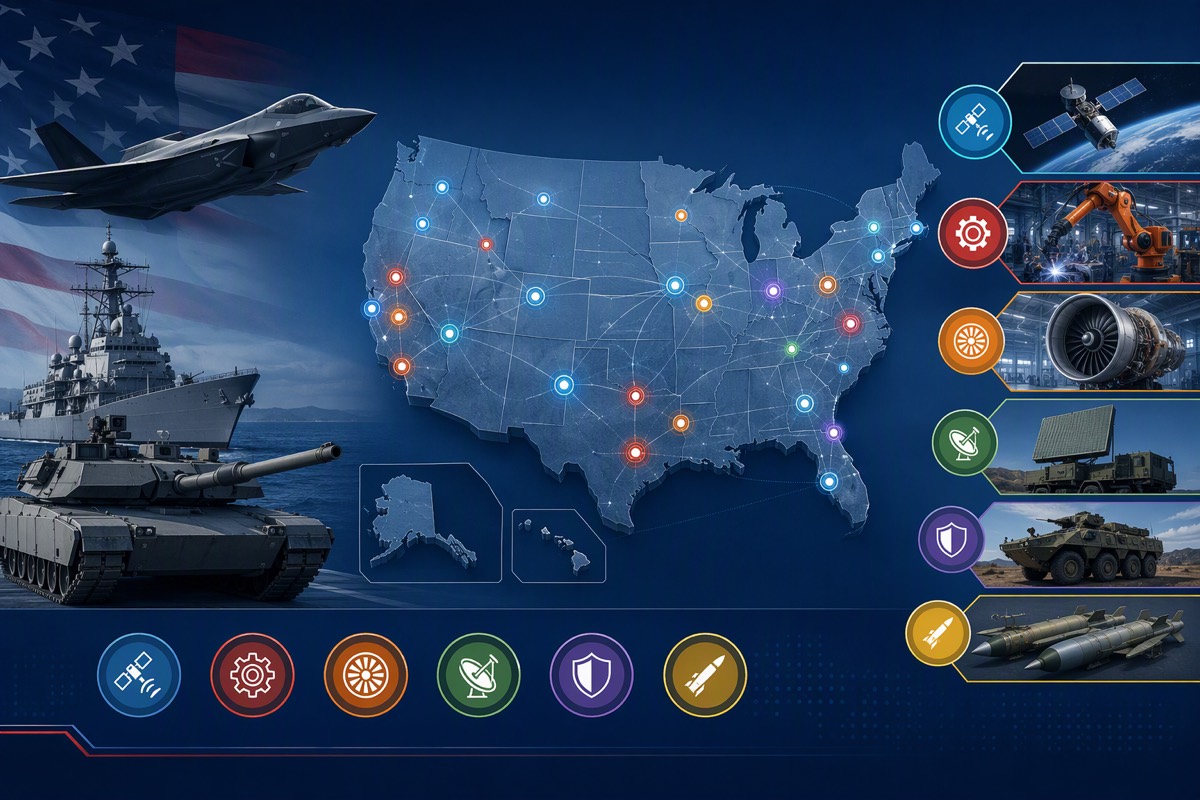
Revenue rankings show commercial scale, not who can manufacture a required component. We map finished platforms, subsystems, components, materials, and production technologies. Our framework for comparing defense companies by revenue, contracts, capabilities, and momentum adds context that a single ranking cannot provide.
Munitions and Energetics
A useful munitions map connects ammunition and missile programs to propellants, explosives, casings, fuzes, guidance components, and production equipment.
A prime contract is only a starting point. Researchers must determine whether plants and suppliers can support the required production rate.
Shipbuilding and Maritime Systems
Shipbuilding analysis should cover yards, repair facilities, module fabricators, propulsion suppliers, casting producers, electronics companies, and specialist equipment manufacturers.
Nominal capacity means little without dry-dock access, skilled labor, reliable module flow, and supplier performance.
Aerospace, Autonomy and Space
We separate airframe and engine manufacturers from avionics, sensors, propulsion, payloads, unmanned systems, and precision-component suppliers.
Autonomy companies require careful classification. Qualified suppliers, production contracts, accepted deliveries, and deployed systems provide stronger evidence than prototypes alone.
Microelectronics and Critical Components
Semiconductors, advanced packaging, trusted electronics, batteries, rare-earth components, and machine tools belong in the same industrial map as visible platform manufacturers.
Domestic assembly may still rely on overseas fabrication, materials, packaging, or equipment. Component-level research exposes those dependencies.
Prime Contractors Versus Lower-Tier Defense Suppliers
Prime contractors integrate systems and manage major customer relationships. Lower-tier manufacturers supply the propulsion, electronics, castings, forgings, materials, and precision parts that make integration possible.
A small specialist can limit an entire program when it supplies a hard-to-replace component.
Where Production Constraints Actually Sit
Common areas of concern include:
- Castings and forgings
- Energetics and propellants
- Trusted electronics
- Propulsion components
- Precision machining
- Specialized materials
Risk is higher when replacement suppliers require lengthy qualification or scarce tooling. We recommend mapping these relationships at the product and program level.
Why Generic Prime Rankings Fall Short
Revenue and award value show scale, but not network resilience, supplier substitutability, or available production capacity.
Prime-level reporting can conceal bottlenecks far below final assembly. A useful defense supply-chain view connects major contractors to the suppliers that influence delivery.
Why Contract Value Is Not Manufacturing Capacity
A large award does not prove delivery strength. We connect contracts to the responsible company, facility, production line, suppliers, program, and schedule.
Backlog, current output, tooling, workforce, lead times, and supplier readiness provide better operating evidence. Funded equipment and active construction are more meaningful than unsupported capacity targets.
Capacity Signals That Matter
Useful signals include:
- Facility expansions and installed production lines
- Capital-equipment purchases
- Hiring, training, and added shifts
- Accepted deliveries and demonstrated output
- Quality performance and program milestones
- Qualified alternate suppliers
- Long-lead material availability
- Evidence of surge capacity
The strongest cases combine physical investment with sustained deliveries.
Read Contract Announcements in Context
An announced value may represent a maximum ceiling rather than obligated funding. Options, future task orders, and potential quantities are not secured production revenue.
Likewise, a prototype award supports development activity but does not necessarily indicate recurring manufacturing demand.
Where Defense Manufacturing Happens in America
We map defense production to individual facilities rather than headquarters. Each site record should identify products, programs, processes, ownership, and operating status.
Company-owned plants, leased sites, government-owned facilities, and proposed factories carry different levels of control and execution risk.
Testing Domestic Manufacturing Claims
Researchers should distinguish among:
- Full production
- Component manufacturing
- Final assembly
- Testing and qualification
- Engineering and development
- Warehousing and distribution
- Sales and administration
A domestic address is not enough. We also examine who owns the equipment and where critical materials, machinery, and components originate.
Geographic Concentration as a Risk Signal
Industrial clusters can improve access to skilled workers and suppliers, but they may also concentrate exposure to labor shortages, disrupted logistics, severe weather, or infrastructure constraints.
Several programs drawing on the same workforce, port, supplier group, or specialist facility may face a shared bottleneck.
Defense Startups, Funding and the Path to Scaled Production
Fundraising and technical promise are not substitutes for manufacturing readiness. We compare emerging and established companies using the same operating evidence.
Funding should be reviewed alongside contracts, facilities, production milestones, and customer adoption. Demonstrations alone do not establish repeatable delivery.
Signals of Scale Readiness
We look for:
- Qualified suppliers
- Installed production tooling
- Documented quality systems
- Experienced manufacturing leaders
- A trained workforce
- Accepted deliveries
- Follow-on orders
- Credible expansion plans
- Improving lead times and unit economics
The key question is whether a company can increase production without losing quality or missing schedules.
Investment Diligence Questions
Investors should ask:
- Which production capabilities does the company control?
- Which critical processes are outsourced?
- How concentrated are its customers, suppliers, programs, and facilities?
- Has it delivered repeatable units?
- How much capital is needed to reach qualified production?
- Does its valuation reflect operating evidence or mainly technical promise?
These questions help us distinguish durable manufacturers from businesses built primarily around an attractive narrative.
Research American Defense Manufacturing with DefDex
DefDex maps the Arsenal of Democracy by organizing companies, capabilities, contracts, funding, and industrial relationships. It helps researchers identify manufacturers beyond the largest primes.
Our basic workflow is:
- Define the required capability.
- Identify manufacturers and suppliers.
- Review contract and funding evidence.
- Connect companies to facilities and programs.
- Assess production maturity and dependencies.
For Defense Analysts
Analysts can connect contractors, facilities, programs, capabilities, and dependencies in one research structure. This makes assumptions easier to test and evidence gaps easier to find.
For Business Development Leaders
Business development teams can identify customers, suppliers, teammates, and acquisition targets by capability rather than name recognition. This approach also surfaces lower-tier companies that prime-focused lists miss.
For Investors
Investors can compare established manufacturers and emerging entrants through operating, contract, and funding signals. Facilities and accepted deliveries provide a practical check on technical claims.
Questions a Defensible Database Should Answer
A useful database should answer:
- Who physically manufactures the product in the United States?
- Which facilities and suppliers support the program?
- What evidence validates each company’s capabilities?
- Where do bottlenecks and single-source dependencies remain?
- Which domestic systems retain foreign supply-chain exposure?
Map the American Defense Industrial Base
Use DefDex to build evidence-based supplier lists, capability maps, competitive landscapes, and investment screens. Start researching American defense manufacturing beyond the prime-contractor level.
Frequently Asked Questions
What qualifies as American defense manufacturing?
It is the domestic production of defense systems, components, materials, and enabling equipment. We look for a relevant U.S. facility, controlled manufacturing activity, defense-market evidence, and supply-chain data.
How can analysts verify domestic production?
Start at the facility level. Confirm what the site does, whether it is operating, and which products or programs it supports. Contracts, certifications, hiring activity, production disclosures, and accepted deliveries can strengthen the assessment.
Why is contract value a poor capacity measure?
Contract value describes potential commercial scope, not physical throughput. Capacity depends on equipment, workers, materials, suppliers, quality performance, lead times, and demonstrated delivery.
Why do lower-tier suppliers matter?
They often make specialized parts that primes cannot replace quickly. A sole qualified source for electronics, energetics, castings, or machined components can constrain a much larger program.
How should investors assess a defense manufacturing startup?
We recommend looking beyond funding and demonstrations. Production tooling, qualified suppliers, quality systems, accepted deliveries, follow-on orders, and credible expansion plans provide stronger evidence of manufacturing readiness.