
Blog
Defense Health Agency Buyer and Contract Opportunity Map
DHA buyers, contract vehicles, incumbents and recompete signals for contractorsPublished · Updated · By DefDex
On this page 14
- Short answer
- What the Defense Health Agency Is—and What It Buys
- DHA, TRICARE, and the Military Health System Are Not the Same Market
- Why the DHA Organization Chart Is a Poor Account-Planning Tool
- Follow DHA Budget and Spending Evidence, Not Announcements
- Major DHA Contract Vehicles, Task Orders, and Recompete Signals
- Where DHA Demand Is Concentrated
- Map DHA Incumbents and Teaming Paths Without Creating Another Contractor Ranking
- How to Find and Qualify DHA Opportunities Before Release
- DHA Entry Paths for Small Businesses and Defense Startups
- Defense Health Agency Headquarters, Contacts, Locations, Logins, and Jobs
- Build a Data-Backed DHA Account Map
- Related guides
- FAQ

Short answer
How should contractors research Defense Health Agency contract opportunities?
The defense health agency is a Department of Defense combat support agency within the Military Health System. It is not synonymous with TRICARE or subordinate to the Army. We recommend mapping requirement ownership, funding, contracting authority, vehicles, incumbents, and recompete timing before pursuing DHA work. Award history and recurring obligations often provide clearer evidence of demand than organization charts or modernization announcements.
Key takeaways
- DHA is a Department of Defense agency, not an Army subordinate, and the end user, funder, program office and contracting office may belong to different organizations.
- Treating DHA and TRICARE as interchangeable can hide demand in technology, cybersecurity, logistics, research and clinical support.
- Account maps should distinguish six roles: mission owner, program office, funding organization, contracting office, technical evaluator and operational user.
- By the time a solicitation is released, vehicle selection, incumbent knowledge and prior engagement may have shaped the field, so ownership should be validated before release.
What the Defense Health Agency Is—and What It Buys

The Defense Health Agency supports the Military Health System as a Department of Defense combat support agency. DHA describes responsibilities spanning clinical care, education, training, logistics, research, information systems, and enterprise management, all in support of warfighter readiness.
For contractors, that mission can create demand beyond direct healthcare delivery:
- Health technology and system sustainment
- Cybersecurity, identity, and infrastructure
- Cloud, data, and interoperability services
- Medical logistics and facilities support
- Research, analytics, and program support
- Clinical staffing and specialized services
Here, we focus on buyers, acquisition paths, and contract signals. Our separate guide covers defense companies, contracts, capabilities and momentum.
Is DHA part of the Department of Defense?
Yes. DHA is part of DoD and operates within the broader Military Health System.
It is not a military department. Army, Navy, and Air Force medical organizations can remain stakeholders even when DHA manages shared capabilities or services.
Is DHA under the Army?
No. DHA is a DoD agency, not an Army subordinate.
Service stakeholders may shape requirements affecting their personnel or installations, but influence does not prove acquisition ownership. The end user, funder, program office, and contracting office may belong to different organizations.
DHA, TRICARE, and the Military Health System Are Not the Same Market
DHA supports uniformed services healthcare, including TRICARE, but TRICARE is not another name for the agency. Treating them as interchangeable can hide demand in technology, cybersecurity, logistics, research, and clinical support.
The Military Health System is the wider DoD health enterprise. DHA, service medical organizations, Defense Health Networks, and military treatment facilities may each help define, fund, buy, or use a capability.
| Requirement pattern | Likely starting point | Validation needed |
|---|---|---|
| Enterprise capability | DHA program office | Funder and contracting office |
| Managed-care service | TRICARE-related organization | Region, vehicle, and buyer |
| Operational medicine need | Service medical organization | DHA acquisition role |
| Hospital or clinic need | Facility or network | Local or aggregated funding |
Who owns the requirement?
Enterprise capabilities may point to a DHA program, while operational medicine can remain service-specific. Facility needs may begin locally.
We verify ownership rather than infer it. A hospital user may rely on funding from one office and an award issued elsewhere.
When a hospital need becomes an enterprise opportunity
Local demand can expand when several facilities need the same capability, DHA applies a common standard, or purchasing is consolidated.
Our account mapping therefore follows the requirement through the funding source, program office, contracting office, and expected vehicle.
Why the DHA Organization Chart Is a Poor Account-Planning Tool
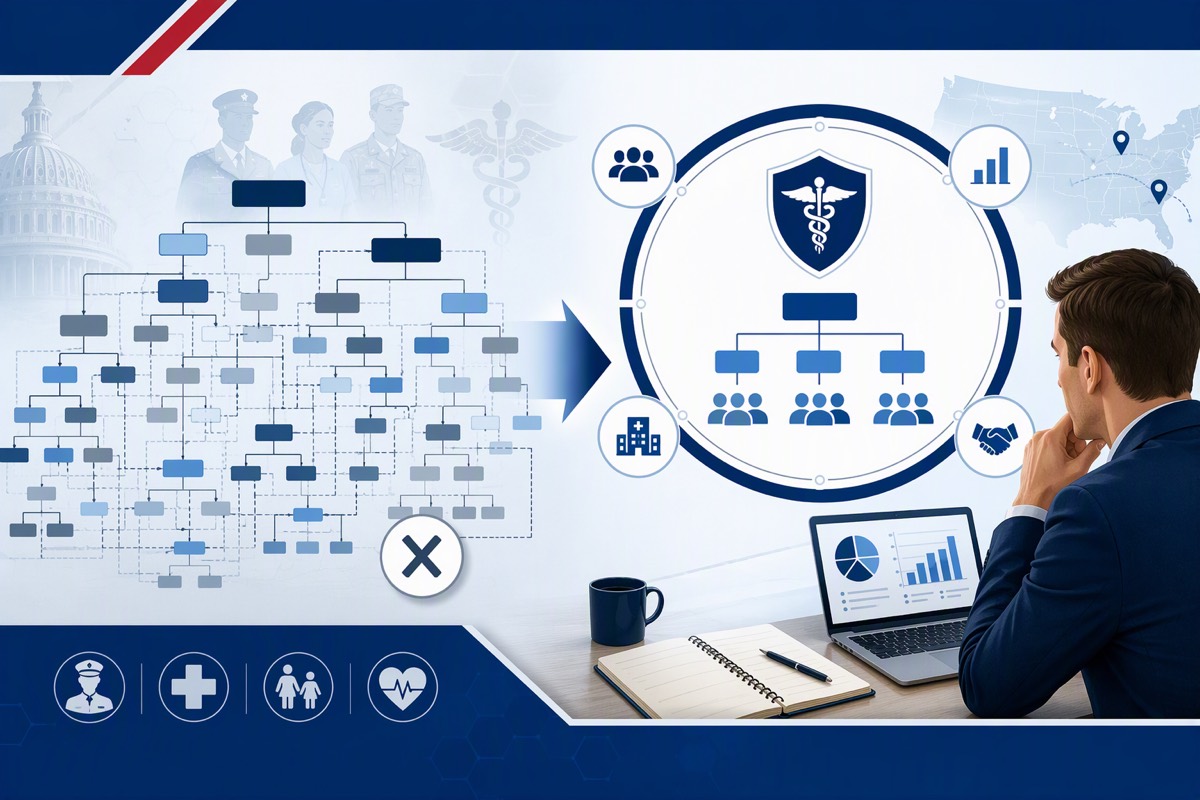
An organization chart shows reporting relationships. It rarely identifies who controls funding, writes requirements, evaluates technology, or selects the acquisition route.
Our account maps distinguish six roles:
- Mission owner
- Program office
- Funding organization
- Contracting office
- Technical evaluator
- Operational user
The six roles to map before capture begins
Mission owners define outcomes, while users reveal workflow and deployment constraints. Neither necessarily controls procurement.
Funding and program offices establish whether demand has resources behind it. Contracting offices and vehicles determine how companies can compete.
Central governance does not mean centralized buying
DHA may standardize architecture, cybersecurity, or clinical processes while purchasing remains distributed across programs, networks, facilities, and vehicles.
We recommend building relationships across mission, program, acquisition, and operational teams rather than relying on one headquarters contact.
Follow DHA Budget and Spending Evidence, Not Announcements
Budget documents, forecasts, transaction records, and award notices answer different questions. No single source provides a complete market view.
Contractors should separate requested funding, enacted funding, obligations, contract ceilings, and task-order values. A ceiling represents potential capacity, not realized revenue.
A source hierarchy for sizing the account
We use budget materials for mission direction, forecasts for expected acquisitions, and awards or modifications to confirm buying activity. Periods of performance, options, and bridge actions help establish timing.
Our guide explains how to turn the Federal Procurement Data System into defense market intelligence.
Signals that a priority is funded and durable
Useful signals include recurring obligations, related task orders, exercised options, follow-on notices, and continued support after deployment.
We separate isolated pilots from repeat demand. A visible announcement matters less than a funded transition path.
Major DHA Contract Vehicles, Task Orders, and Recompete Signals
DHA requirements may use standalone contracts, indefinite-delivery vehicles, government-wide vehicles, blanket purchase agreements, or task orders. Each route creates a different competitive field.
Technical fit does not guarantee prime access. If a company lacks the required vehicle, partnering may be the stronger approach.
Build a DHA recompete watchlist
For each target, we track:
| Field | Why it matters |
|---|---|
| Incumbent and award ID | Connects work to transaction history |
| Contracting office | Identifies the acquisition channel |
| Vehicle | Defines prime eligibility |
| Obligations | Shows funded activity |
| End dates and options | Clarify timing |
| Related notices | Reveal follow-on activity |
Why solicitation-first capture is already late
By solicitation release, vehicle selection, incumbent knowledge, and prior engagement may have shaped the field.
Before release, we validate ownership, monitor market research, assess vehicle access, and identify teammates. The solicitation should confirm the strategy rather than create it.
Where DHA Demand Is Concentrated
We organize demand around buying evidence, not generic priority lists. Discussion of a capability does not by itself establish funded demand.
Digital health, EHR, and interoperability
Digital health work may include deployment, sustainment, integration, data exchange, analytics, training, and support. These layers can have different owners and acquisition paths.
We separate enterprise modernization from facility implementation and continuing operations.
Cybersecurity, cloud, and enterprise infrastructure
Potential requirements include identity, hosting, networks, monitoring, compliance, and incident support. Strategy documents provide context, but awards and funded actions show actual purchasing.
The visible user may not issue the contract; another DHA or DoD organization may buy the service.
Virtual care, logistics, and clinical support
These services may be acquired at enterprise, regional, or local levels. That distinction affects ownership, staffing, pricing, and vehicle selection.
For pilots, we look for an acquisition owner, follow-on funding, and a route to deployment.
Map DHA Incumbents and Teaming Paths Without Creating Another Contractor Ranking
DHA capture calls for account-specific incumbent analysis. We connect prime awards, funded orders, predecessor contracts, subcontract signals, and partner announcements.
Company-wide revenue does not prove strength on a particular recompete. For broader context, see our Department of Defense market guide to budgets, buyers, programs and contractors.
What incumbent advantage actually looks like
Relevant advantages can include active task orders, vehicle access, experienced staff, facility presence, operational knowledge, and manageable transition risk.
We also test whether those advantages fit the follow-on scope. A changed architecture, acquisition strategy, or set-aside can reshape the field.
When to partner instead of prime
Partnering may be preferable when another company controls vehicle access, customer past performance, or integration work.
Strong partnerships establish workshare and mission value early. They are not names added after the solicitation appears.
How to Find and Qualify DHA Opportunities Before Release
Our workflow combines notices, forecasts, award records, task orders, modifications, budget materials, and agency communications. Searching only for “Defense Health Agency” can miss records associated with programs, offices, vehicles, or other DoD entities.
Search terms and identifiers that uncover hidden activity
We track contracting offices, program names, contract numbers, incumbents, vehicles, places of performance, classification codes, and predecessor awards.
Because funding agencies, buyers, and users may appear differently across systems, entity resolution is essential.
A data-first DHA qualification checklist
Before committing resources, confirm:
- Mission customer and operational user
- Program, funding, and acquisition owners
- Procurement path and vehicle access
- Obligations and expected timing
- Incumbent position and teaming needs
- Technical and transition risks
A large solicitation can still be a poor pursuit. A funded subcontract may offer a more credible entry.
DHA Entry Paths for Small Businesses and Defense Startups
New vendors can consider prime bids, set-asides, subcontracts, vehicle partnerships, pilots, and other authorized acquisition pathways.
We do not count innovation activity as scalable demand without an acquisition owner and transition funding.
Prime, partner, or pilot?
Prime when access, past performance, and delivery capacity align. Partner when another company provides the required vehicle or customer position.
Use pilots when they can produce a credible mission outcome and have a defined follow-on path.
Questions to ask before joining a team
Clarify workshare, customer access, proposal roles, exclusivity, data rights, vehicle access, and funding status before investing substantial resources.
Defense Health Agency Headquarters, Contacts, Locations, Logins, and Jobs
USAGov lists DHA’s main address as 7700 Arlington Boulevard, Suite 5101, Falls Church, Virginia 22042-5101. We recommend checking official sources before travel or correspondence.
Where is DHA headquarters?
DHA’s listed main address is in Falls Church, Virginia. That address does not identify which office owns a particular requirement.
Where should contractors look for contacts and opportunities?
Use forecast, sources-sought, and solicitation contacts for acquisition questions. Official DHA and Military Health System pages are better suited to current locations, portals, patient services, and jobs.
Build a Data-Backed DHA Account Map
Use defdex.io to connect DHA buyers, awards, incumbents, vehicles, and recompete signals. Start building a funded, evidence-based account map before the solicitation defines the field.
Frequently Asked Questions
What is the Defense Health Agency?
DHA is a DoD combat support agency within the Military Health System. Its responsibilities include clinical care, training, logistics, research, information systems, and enterprise management.
Is DHA part of DoD?
Yes. DHA is a Department of Defense agency, distinct from the Army, Navy, and Air Force.
Is the Defense Health Agency the same as TRICARE?
No. DHA supports uniformed services healthcare, including TRICARE, but its responsibilities extend beyond that health plan.
Is DHA under the Army?
No. Army organizations may be stakeholders or users, but DHA is not subordinate to the Army.