
Blog
National Defense Strategy: A Market Guide to the 2026 Shift
How the 2026 strategy's reported priorities trace into budgets and contractsPublished · Updated · By DefDex
On this page 13
- Short answer
- What Is the Pentagon National Defense Strategy for 2026?
- Official National Defense Strategy PDF, Sources, and Verification
- National Defense Strategy vs. National Security Strategy and National Military Strategy
- What Changed From the 2022 and Earlier National Defense Strategies?
- Regional Priorities: Homeland, China, Russia, and North Korea
- Allied Burden-Sharing and the Defense Market
- Budget Crosswalk: Which Priorities Are Actually Funded?
- Capability Demand and Industrial-Base Implications
- What the Strategy Means for Contractors, Startups, and Investors
- Track the Strategy Through Market Evidence
- Related guides
- FAQ

Short answer
Is the 2026 National Defense Strategy a spending plan, and what changed?
The Pentagon National Defense Strategy is a planning framework, not a spending plan. January 2026 reporting described a shift toward homeland and Western Hemisphere defense, more limited support for allies, and greater burden-sharing. We recommend verifying the official document, then tracing its priorities through budgets, appropriations, programs, contracts, and fielding decisions.
Key takeaways
- The National Defense Strategy guides the Department of Defense, but it does not appropriate money or award contracts.
- Because we could not verify an authenticated Defense Department PDF, the 2026 priorities are treated as reported priorities rather than verified quotations from the official document.
- Strategy language alone does not make a capability area a market winner, and confidence rises when budget lines, quantities, appropriations, command requirements and awards align.
- Burden-sharing changes who buys and fields a capability, but it does not automatically reduce total demand.
What Is the Pentagon National Defense Strategy for 2026?
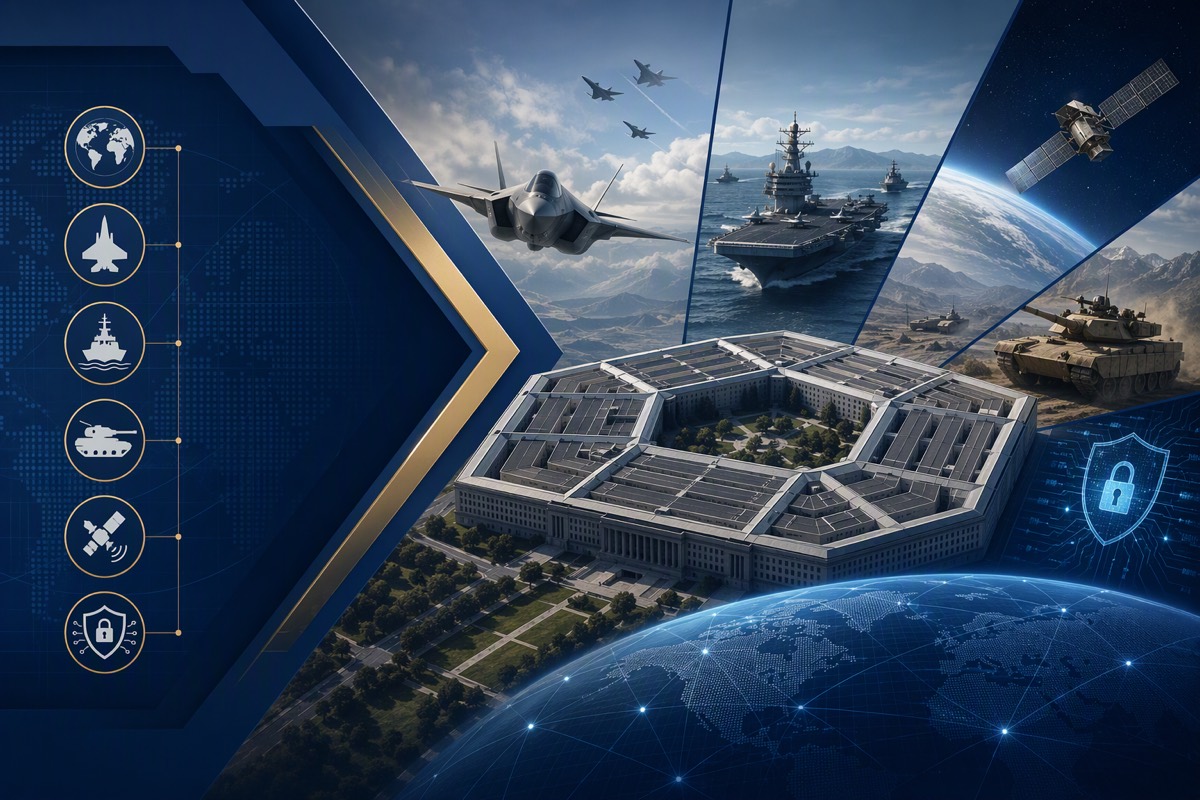
The National Defense Strategy translates presidential security objectives into Pentagon priorities for force planning, posture, and resources. It guides the Department of Defense, but it does not appropriate money or award contracts.
January 2026 reporting described a strategy that placed the U.S. homeland and Western Hemisphere first, retained deterrence of China, and sought greater allied burden-sharing. We could not verify an authenticated Defense Department PDF of the strategy, so we treat those points as reported priorities rather than verified quotations from the official document.
National Defense Strategy 2026 Release Date and Document Status
BBC reporting dated January 24, 2026 described the new strategy. It also noted that these strategies are generally published every four years.
Because the source is secondary reporting, we would confirm the formal title, release date, issuing notice, and public-document scope against a Defense Department publication page before citing them as official facts.
Who Writes and Approves the National Defense Strategy?
The National Defense Strategy is issued under civilian Defense Department leadership. Pentagon policy officials develop it with input from military and defense organizations, while the President provides higher-level national-security direction.
Congress does not write the strategy, but it can shape implementation through legislation, oversight, authorization, and appropriations. Outside advisers may influence the debate without being formal authors.
Official National Defense Strategy PDF, Sources, and Verification
An official Defense Department PDF and its corresponding publication page should be the primary sources. They establish the title, date, issuing authority, and whether the public file is a complete strategy or a summary of classified guidance.
We rank evidence in this order:
- Authenticated Defense Department publications.
- Legislation, budget exhibits, and official testimony.
- Acquisition records, solicitations, and awards.
- On-record reporting.
- Leaks, reposted files, and unattributed excerpts.
How to Authenticate the Pentagon Strategy Document
Before citing a document, we check its government domain, issuing office, publication date, metadata, archived release page, and version status. Quotations should match the official file.
A plausible filename or reposted PDF is not enough. News coverage can identify a document and summarize its themes, but it should not replace the issuing record.
Where the Classified Strategy and Public Summary Diverge
A public summary may omit operational assumptions, intelligence judgments, force-sizing methods, readiness standards, and contingency plans. Those gaps matter because broad phrases such as “homeland defense” do not reveal how forces or funding will be allocated.
We therefore use procurement, posture, exercises, budgets, and contracts as supporting evidence without presenting them as proof of classified guidance.
National Defense Strategy Vs. National Security Strategy and National Military Strategy

| Document | Issuer | Main Role |
|---|---|---|
| National Security Strategy | President | Sets government-wide security objectives |
| National Defense Strategy | Defense Department civilian leadership | Converts national objectives into defense priorities |
| National Military Strategy | Senior military leadership | Translates defense priorities into military objectives |
| Defense Planning Guidance | Defense Department leadership | Directs internal planning and resource submissions |
Who Wrote Trump’s National Security Strategy?
A presidential National Security Strategy is issued under the President through the White House national-security process. It is distinct from the Pentagon’s National Defense Strategy.
We attribute individual authorship only when an official record or reliable on-record reporting supports it. Political influence alone does not establish formal ownership.
How Strategy Moves Into Force Planning
The broad sequence runs from national strategy to defense and military planning, followed by program submissions, budget requests, congressional action, acquisition, and fielding.
These stages do not always move together. A new strategy may appear after major budget decisions have been made, so procurement effects can lag behind political announcements.
What Changed From the 2022 and Earlier National Defense Strategies?
The reported 2026 direction changes emphasis rather than replacing every existing mission.
| Issue | Earlier Emphasis | Reported 2026 Direction |
|---|---|---|
| Leading priority | China as the top defense challenge | Homeland and Western Hemisphere first |
| China | Central planning challenge | Strength and deterrence without emphasizing confrontation |
| Allies | Cooperation and integrated deterrence | Greater burden-sharing |
| Homeland defense | Major mission | Elevated organizing priority |
| Industrial capacity | Resilience and innovation | Continued focus on production and readiness |
The Priorities That Gained Weight
Likely capability implications include aerospace warning, air and missile defense, counter-drone systems, cyber defense, Arctic access, maritime awareness, resilient communications, and critical-infrastructure protection.
We would not classify those areas as market winners based on strategy language alone. Confidence rises when budget lines, quantities, appropriations, command requirements, and awards align.
The Missions and Regions That May Lose Resources
Open-ended overseas commitments and some U.S.-funded allied support roles could face pressure. Legacy systems may also be vulnerable if they do not support the revised priorities.
These are analytical possibilities, not confirmed cuts. Congress can resist divestments, base changes, and reductions in allied support.
Regional Priorities: Homeland, China, Russia, and North Korea
Regional missions compete for limited assets, including air defenses, submarines, aircraft, intelligence systems, precision munitions, sealift, and logistics. Actual allocation reveals more than slogans.
Homeland and Western Hemisphere Defense
A funded “homeland first” approach should become visible in sensors, integrated defenses, counter-drone systems, cyber programs, Arctic capabilities, maritime awareness, infrastructure protection, and basing.
We test that thesis against budget requests, enacted appropriations, procurement schedules, military construction, solicitations, and awards.
China and Strategic Access in the Indo-Pacific
Homeland defense can rank first politically while China continues to shape force design. Undersea warfare, long-range fires, resilient bases, distributed logistics, space systems, fuel storage, and pre-positioned supplies remain relevant indicators.
Demand may extend beyond weapons to communications, power, maintenance, inventory systems, runway repair, and base hardening.
Russia, NATO, and North Korea
More limited U.S. support could prompt NATO members to invest in air defense, ammunition, drones, logistics, and command systems. Domestic purchasing rules and production constraints will affect which suppliers benefit.
North Korea also sustains demand for missile defense, readiness, partner support, and deterrence. That does not give every regional mission equal planning weight.
Allied Burden-Sharing and the Defense Market
Burden-sharing changes who buys and fields a capability. It does not automatically reduce total demand.
Partner purchases can involve foreign military sales, direct commercial sales, export approvals, local production, training, and sustainment. Announced spending goals are not the same as appropriated budgets, signed agreements, contracts, deliveries, or operational capability.
Where U.S. Suppliers Could Gain
Potential opportunities include munitions, air and missile defense, sensors, command-and-control, aviation support, training, spares, and sustainment. Installed equipment and interoperability requirements can support U.S. suppliers.
Export controls, financing, backlogs, and technology-release decisions may delay or redirect that demand.
Where Sovereign Capacity Could Limit U.S. Share
Allied governments may favor domestic suppliers, local-content rules, licensed production, industrial offsets, or technology transfer. A U.S.-origin system does not guarantee that most contract value remains with U.S. companies.
Co-production can preserve supplier participation while moving assembly and sustainment to the purchasing country.
Budget Crosswalk: Which Priorities Are Actually Funded?
A strategy is not a spending plan. We trace each priority through budget requests, congressional authorization, appropriations, reprogramming, procurement quantities, solicitations, awards, deliveries, and fielding.
Research is not procurement. Procurement is not fielding. Requested funding is not enacted funding.
Our guide to turning the Federal Procurement Data System into defense market intelligence explains why obligations, award ceilings, modifications, and recipient structures must be separated.
Evidence Hierarchy From Aspiration to Contract
We treat speeches and strategy language as low-confidence market signals. Budget exhibits, prototypes, and solicitations provide stronger evidence. Enacted funding, production contracts, repeat awards, deliveries, and capacity investments provide the clearest support.
Our DefDex methodology separates thematic relevance from observable market activity.
Signals of a Likely Winner or Loser
Positive signals include rising quantities, production expansion, multiyear procurement, program acceleration, and prototypes moving into production.
Warning signs include falling quantities, delays, planned divestments, unfunded requirements, cancellations, and repeated prototype awards without a production path.
Capability Demand and Industrial-Base Implications
Likely themes include munitions, air and missile defense, autonomy, space, cyber, electronic warfare, resilient communications, logistics, shipbuilding, and production infrastructure.
Constraints may sit below prime contractors in propulsion, microelectronics, materials, shipyard capacity, labor, and secure supply chains.
Near-Term Demand With Observable Procurement Pull
Replenishment, mature munitions, air defense, counter-drone systems, sustainment, spares, and capacity expansion offer relatively visible procurement signals. We can test them through quantities, appropriations, and defense contract awards.
Urgent replenishment should not automatically be modeled as permanent growth.
Longer-Horizon Demand Dependent on Transition
Autonomy, artificial intelligence, advanced networks, space architectures, directed energy, and new manufacturing methods may fit the strategy while remaining commercially immature.
The key tests are operational sponsorship, integration, testing, production authority, recurring funding, and a scalable supply chain.
What the Strategy Means for Contractors, Startups, and Investors
Contractors should examine program concentration, recompete risk, supply dependencies, and whether existing products support the revised missions. Startups need to distinguish experiments from recurring procurement.
Investors should separate strategic exposure from revenue exposure. Valuation, customer concentration, production problems, export controls, and policy reversals can undermine a sound theme.
DefDex connects companies, capabilities, programs, budgets, contracts, and partner demand across the defense market.
A Strategy-to-Company Screening Framework
We assess mission alignment, funded-program participation, contract momentum, production readiness, buyer diversity, allied access, and supply-chain control.
Downside screens include legacy concentration, divestment exposure, unfunded claims, and dependence on one customer, program, or acquisition route.
FAQ: Authority, War Preparation, and Document Ownership
Military readiness, exercises, posture changes, and stockpiling prepare for contingencies. They do not independently prove a political decision to begin a war.
Likewise, military leaders advise and execute lawful policy but do not independently replace civilian strategy.
Track the Strategy Through Market Evidence
Use DefDex to follow Pentagon priorities from strategy language into budgets, programs, contracts, production capacity, and allied demand. Track the funded market before acting on the headline.
Frequently Asked Questions
Can the U.S. Military Override the President?
No. The military operates under constitutional civilian control and follows lawful orders. Duties concerning unlawful orders do not create a general military power to veto presidential policy.
Who Wrote Trump’s National Security Strategy?
It was issued under the President through the White House national-security process. Individual contributors should be named only when reliable records establish their roles.
What Is the United States’ National Defense Strategy for 2026?
January 2026 reporting described homeland and Western Hemisphere defense as the leading priority, alongside continued China deterrence and greater allied burden-sharing. Exact language should be checked against the official Pentagon document.
Is the U.S. Preparing for War?
The United States maintains readiness, exercises, stockpiles, force posture, and contingency plans. Those activities support deterrence and response options; they do not by themselves prove an intention to start a war.
Who Owns the National Defense Strategy?
The strategy belongs to the Department of Defense under civilian leadership. Military organizations help develop and implement it, while Congress shapes execution through legislation, oversight, and funding.