

Identity and Data Scope
SpaceWERX is listed as a command. No parent organization is recorded.
No prime-contract activity is published for this body in this build. This does not establish that SpaceWERX has no budget, makes no purchases or has never awarded a contract.
This body is outside, or has no recorded parent linking it to, the DoW, DHS, DOE and NASA baseline. Its profile and any catalog awards do not establish a complete contracting history. These are prime-contract obligations, not budget authority, outlays or announced ceilings. Subcontracts and assistance are not part of this prime-contract view. Program lists identify reported acquisition codes; an absent program link does not mean the body has no programs.
Verify identifiers and award records on USAspending; use the baseline and promotion rules to distinguish totals from the awards served individually.
Guide · by DefDex · reviewed
What is SpaceWERX?
SpaceWERX connects commercial space technology with Department of the Air Force and U.S. Space Force needs through SBIR/STTR opportunities, transition support and related acquisition pathways. We do not treat an award as proof of operational adoption. Our diligence focuses on obligated funding, customer sponsorship, follow-on contracts and documented use.
AI-generated illustration by SeoSorted for DefDex; not a photograph or verified market data.
The guide's review date is separate from the contract data cutoff shown with the data.
- Nov 20, 2026NewsSpaceNewsPiLogic testing satellite fault-prediction platform with SpaceWERX
- Nov 16, 2026CompanyTurion SpaceTurion Space Completes Critical Design Review for GEO Space Domain Awareness Spacecraft Under U.S. Space Force STRATFI
- Aug 21, 2026CompanyThinkOrbitalSpaceWERX Announces 2026 STRATFI Awardees
- Aug 3, 2026NewsTFX CapitalThinkOrbital selected for SpaceWERX Future Series Challenge
- Jun 30, 2025CompanyLeoLabsLeoLabs Selected by USSF to Further Develop Next-Gen, Scout-Class Radar Capabilities to Detect and Track Launches
TL;DR
SpaceWERX connects commercial space technology with Department of the Air Force and U.S. Space Force needs through SBIR/STTR opportunities, transition support and related acquisition pathways. We do not treat an award as proof of operational adoption. Our diligence focuses on obligated funding, customer sponsorship, follow-on contracts and documented use.
What SpaceWERX Does for the U.S. Space Force
AI-generated illustration by SeoSorted for DefDex; not a photograph or verified market data.
SpaceWERX operates as the space-focused part of the broader AFWERX innovation ecosystem. It helps commercial and dual-use companies understand government needs, pursue relevant funding and work toward transition.
We view it as an entry and transition channel, not simply an accelerator. Event participation, selection, contract award, obligated funding, prototype delivery and operational adoption are distinct milestones. Each requires its own evidence.
SpaceWERX’s mission and target technologies
SpaceWERX activities can address space resilience, cybersecurity, data integration, autonomy, logistics and other mission-relevant capabilities. These broad categories signal areas of interest; they do not guarantee funding.
A company still needs to connect its technology to a defined requirement, government customer and valid acquisition route.
SpaceWERX versus a conventional accelerator
Conventional accelerators often emphasize mentorship, investor access or equity financing. SpaceWERX programs can support technical work associated with government requirements and potential transition.
Participation alone does not make a company a government contractor. We look for a signed award and federal obligation before classifying activity as funded.
How SpaceWERX Relates to AFWERX, AFRL and the U.S. Space Force
AFWERX describes itself as the Department of the Air Force’s innovation arm. SpaceWERX focuses that innovation activity on space, while AFRL supports broader research and development work. The U.S. Space Force may act as a mission customer, sponsor or transition partner.
Those roles are not interchangeable. One project can involve separate technical sponsors, contracting offices, program offices and operational customers. Our guide to Department of War innovation front doors provides a broader comparison of AFWERX, DIU and related entry points.
Who runs SpaceWERX?
The supplied official materials do not provide a current, authoritative leadership roster. We therefore avoid naming a leader without an official, date-stamped biography or appointment notice.
Program leadership must also be distinguished from contracting authority and operational budget ownership.
Where are SpaceWERX, AFWERX and Space Force headquarters located?
The U.S. Space Force is headquartered at the Pentagon in Arlington, Virginia. That location should not automatically be assigned to SpaceWERX or AFWERX.
SpaceWERX uses events and partner locations, including a listed Launchpad Session in El Segundo. An event venue is not proof of formal headquarters.
SpaceWERX Funding Pathways Explained
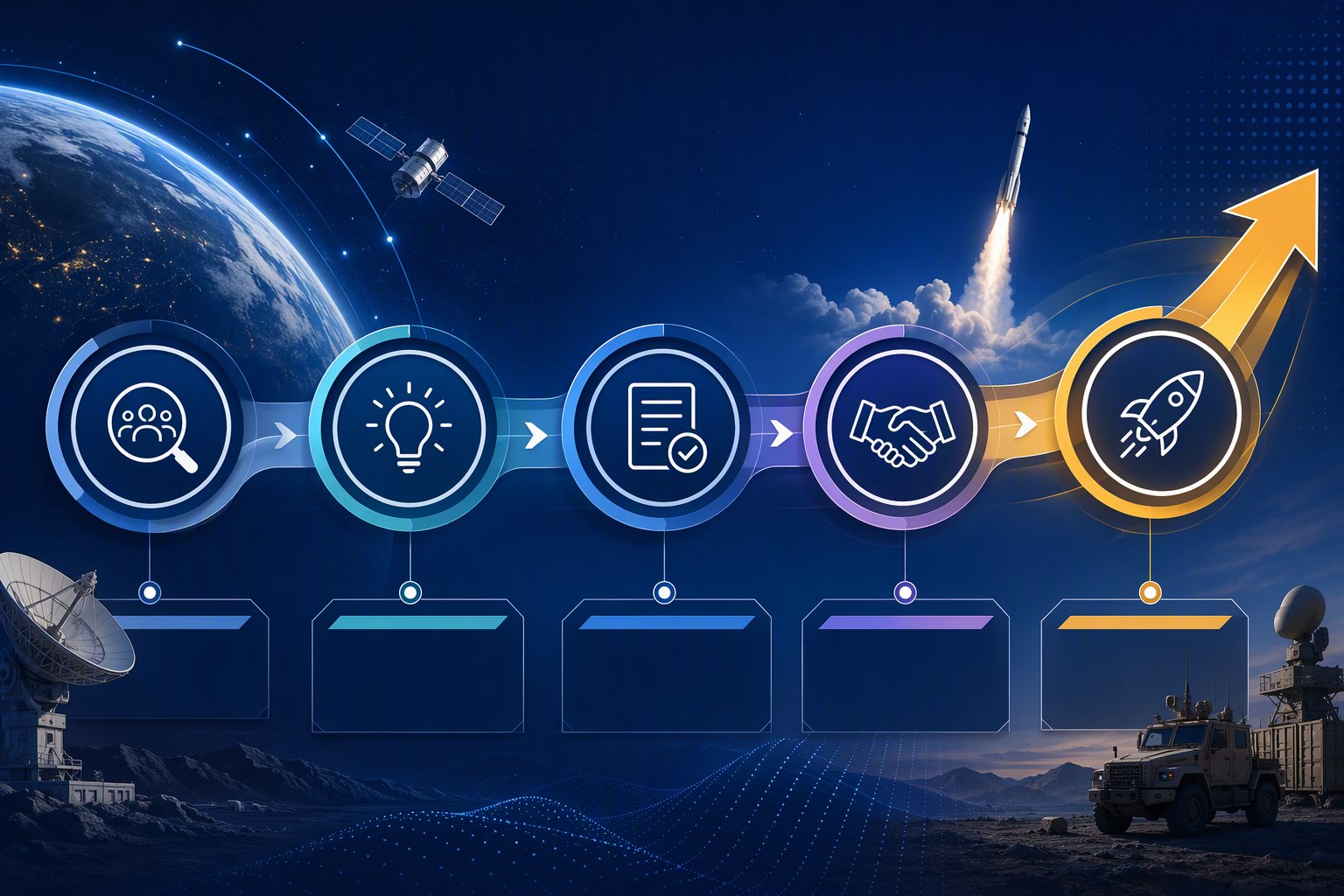
AI-generated illustration by SeoSorted for DefDex; not a photograph or verified market data.
Available pathways depend on the controlling solicitation. Applicants should confirm eligibility, deadlines, funding terms and required documentation there.
| Pathway | General purpose | Key evidence |
|---|---|---|
| Open Topic | Connect a commercial solution to a mission need | Customer discovery and mission fit |
| Specific topic | Address a defined government problem | Compliance with topic requirements |
| Phase I | Examine feasibility | Technical and commercial rationale |
| Phase II or D2P2 | Develop or demonstrate a prototype | Feasibility and customer evidence |
| STRATFI or TACFI | Support later-stage transition | Customer and qualifying commitments |
| Phase III | Continue SBIR/STTR-derived work with other funds | Procurement funding and authority |
Our SBIR and STTR guide covers the underlying program framework.
Open Topic versus specific-topic solicitations
Open Topics require a company to establish the government use case. Specific topics begin with a defined problem but may impose narrower technical and proposal requirements.
Neither format removes the need for customer validation and careful solicitation review.
Phase I, Phase II and Direct-to-Phase II
Phase I generally concerns feasibility, while Phase II supports further research, development or prototyping. Direct-to-Phase II, often shortened to D2P2, allows an applicant to pursue Phase II without receiving a new Phase I award when the applicable requirements are met.
Prior work must be documented. A claim of maturity is not enough.
Phase III and non-SBIR follow-on procurement
Phase III uses funding outside the SBIR/STTR set-aside for work derived from earlier program activity. It may support further development, production or deployment.
We consider a verified Phase III action or other funded follow-on a stronger transition signal than award count alone.
SpaceWERX D2P2, STRATFI and TACFI
D2P2 accelerates entry into prototype work. STRATFI and TACFI are associated with later transition efforts, but their requirements vary by notice.
“Nondilutive” does not mean free of cost. Proposal work, reporting, payment timing, matching expectations and data-rights terms can affect an award’s practical value.
Direct-to-Phase II eligibility and award structure
D2P2 applications may require evidence of prior feasibility work, technical results, a prototype scope, customer interest and a transition plan. The active solicitation controls.
To verify an award, we look for the recipient, contract identifier, effective date and obligated amount. Announcement language is not enough.
STRATFI and TACFI matching capital
Applicable notices may involve government funding alongside private investment or other qualifying commitments. We separate each source rather than presenting a combined headline as government funding.
A maximum value is not necessarily an obligation. Private financing should also be checked against actual funding-round records.
Choosing the right transition path
| Company position | Potential path | Main question |
|---|---|---|
| Feasibility unproven | Phase I | Can the need and approach be validated? |
| Feasibility established | Phase II or D2P2 | Is the evidence sufficient? |
| Prototype ready to scale | STRATFI or TACFI | Are customers and commitments in place? |
| Customer ready to buy | Phase III or another contract | Is procurement funding available? |
We recommend reviewing data rights, reporting duties and likely procurement timing before choosing a path.
SpaceWERX Companies, Awards and Contract Values
A useful portfolio separates recipients by phase, topic, customer, technology, value and status. Feasibility studies should not be counted as equivalent to operational deployments.
What a complete SpaceWERX company record should contain
We capture the legal recipient, technology category, pathway, topic, contract number, dates and obligations. Where available, we also record sponsors, transition partners, private funding, corporate ownership and subsequent contract actions.
Award count versus transition value
Equal award counts can hide very different levels of traction. One company may hold several feasibility awards, while another has a funded follow-on and repeat customer.
We therefore give more weight to obligations, customer continuity and deployment evidence than to raw award volume.
How DefDex verifies SpaceWERX awards
At defdex.io, we reconcile program announcements with solicitations, federal award data, private funding and later contract activity. DefDex also helps separate legal recipient names from trade names and parent companies.
When evidence conflicts or remains unavailable, we label the gap rather than manufacture precision.
From SpaceWERX Prototype to Operational Contract
Transition evidence can include prototype acceptance, program-office sponsorship, follow-on obligations and documented deployment. No single signal proves every stage.
Five levels of SpaceWERX traction
- Participation: Attendance at an event or challenge.
- Selection: Choice for further evaluation or engagement.
- Funded award: A verified contract and obligation.
- Follow-on contract: Additional funded work.
- Operational use: Documented use by a mission customer.
We require a source and date for each level.
Finding follow-on obligations and subcontract relationships
Follow-on work may appear under a different vehicle, agency, prime contractor or company name. Searches should cover modifications, Phase III actions, subcontract relationships and corporate acquisitions.
Warning signs of innovation-funding dependence
Repeated early-stage awards without a transition customer, budget owner or procurement action can indicate reliance on innovation funding. Long development cycles mean delay is not automatically failure. We mark unsupported transition claims as unverified.
SpaceWERX Priorities and Current Opportunities
Opportunity tracking should capture the solicitation number, deadline, eligibility, funding terms and controlling documents. We separate solicitations from challenges, events and educational resources.
The supplied AFWERX page lists 26.BZ, 26.BX and 26.TZ Release 6 opportunities involving SBIR/STTR, D2P2 and Phase I. Status and amendments should be confirmed on the official opportunity page.
Resilient architectures, space domain awareness and cyber
Space resilience, sensing, command and control, cybersecurity and data integration may inform market research. Broad priorities are not the same as open solicitations.
The SpaceWERX archive also lists a Cyber Space Exchange recording focused on Space Force cyber architecture. It provides context, not funding authority.
In-space logistics and advanced manufacturing
Space logistics, servicing and manufacturing may support mission needs, but program branding and award status require verification. We do not treat a challenge or presentation as an award without a supporting contract record.
Industry days, launchpad sessions and recorded webinars
Industry days support requirement discovery. Launchpad Sessions help companies navigate programs such as SBIR and STTR, while recorded webinars explain processes and past notices.
For applications, the current solicitation and its amendments control.
How We Diligence a SpaceWERX-Backed Company
We begin with the legal recipient and contract identifier, then reconstruct obligations, modifications and follow-on actions. Private capital is evaluated separately from government funding.
The SpaceWERX traction checklist
We verify:
- Recipient and contract identifier
- Phase, topic and dates
- Sponsor and intended customer
- Ceiling versus obligated amount
- Modifications and follow-on vehicles
- Transition partner and budget owner
- Prototype or deployment evidence
Private capital and matching-fund risk
A financing round can support operations, but it does not prove government adoption. We compare capital with matching requirements, cash needs, payment timing and the strength of the procurement customer.
Data rights and commercialization economics
Qualified counsel should review solicitation-specific intellectual-property, technical-data and reporting terms. We also assess whether government requirements support the commercial roadmap or create expensive one-off customization.
SpaceWERX Current-Status Brief
Leadership, deadlines, budgets and opportunities change. Every current-status statement should include a verification date and authoritative source.
Who runs SpaceWERX?
The supplied official materials do not establish a current leader. We recommend checking for an official biography or appointment announcement.
Where is U.S. Space Force headquarters?
The U.S. Space Force is headquartered at the Pentagon in Arlington, Virginia. SpaceWERX offices and event locations require separate verification.
How much funding is available for the Space Force?
No single figure answers this question. Budget requests, appropriations, solicitation ceilings, awards and obligations measure different things.
What is the latest Space Force and SpaceWERX news?
The supplied materials list AFWERX Release 6 opportunities and SpaceWERX resources concerning TACFI, Phase III and cyber architecture. Each should be checked against its current controlling document.
Where can applicants find the latest SpaceWERX deadline?
The official solicitation and amendment history are authoritative. Event pages and webinar slides may become outdated.
FAQ
Is a SpaceWERX award proof of Space Force adoption?
No. It confirms more than event participation, but operational adoption requires stronger evidence, such as follow-on funding, customer acceptance or documented fielding.
What is the difference between an award ceiling and an obligation?
A ceiling is the maximum potential contract value. An obligation records funding the government has committed. We keep those figures separate.
Can a company enter through Direct-to-Phase II?
Potentially, if it satisfies the active solicitation’s requirements and can document Phase I-equivalent feasibility.
Are Launchpad Sessions funding opportunities?
They are guidance and engagement events for companies exploring programs such as SBIR and STTR. They are not substitutes for a solicitation or contract award.
How should investors assess SpaceWERX traction?
We recommend reviewing the full timeline: customer engagement, award, obligations, modifications, follow-on contracts and operational evidence.
Build a Defensible SpaceWERX Market Picture
Use DefDex to connect SpaceWERX companies, federal awards, private funding and follow-on activity in one research workflow. Build your market view from verifiable evidence, not isolated announcements.