Defense agency · Code 97DH
Defense Health Agency
The Defense Health Agency (DHA) is the Department of War agency that supports integrated medical services and health activities across the military health system.
- Part ofU.S. Department of War
About
The Defense Health Agency (DHA) is the Department of War agency that supports integrated medical services and health activities across the military health system. DHA Research & Development is within this agency and coordinates defense health research, including the Army medical research command and its subordinate institutes.
Identity and Data Scope
Defense Health Agency is listed as a defense agency within U.S. Department of War.
- Agency code
- 97DH
196,272 prime-contract and research-assistance actions are recorded for this body and its mapped subordinate agencies and offices. These total $234.77B obligated, including negative and zero actions. 66,592 awards are recorded. Contract data: Oct 6, 2026. Department of Defense contract data runs about 90 days earlier than DHS, DOE and NASA data because of DoD’s 90-day publication delay.
The baseline begins in FY2008. This body’s dollar totals include every recipient size; contractor and program breakdowns use the narrower published catalog. These are obligations on prime contracts and on assistance in the reviewed research programs, not budget authority, outlays or announced ceilings. Subcontracts are not included. Flood insurance, DHS disaster and other assistance outside the research allowlist, and non-research DoW, DOE and NASA assistance are left out of this total; the methodology reports each as a separate line. Program lists identify reported acquisition codes; an absent program link does not mean the body has no programs.
Verify identifiers and award records on USAspending; use the baseline and promotion rules to distinguish totals from the awards served individually.
Recorded obligations by fiscal year
| Fiscal year | Obligated (net) |
|---|---|
| FY2026 (partial) (provisional†) | $17.66B obligated |
| FY2025 | $19.77B obligated |
| FY2024 | $20.08B obligated |
| FY2023 | $20.20B obligated |
| FY2022 | $20.06B obligated |
| FY2021 | $18.21B obligated |
| FY2020 | $17.54B obligated |
| FY2019 | $16.82B obligated |
| FY2018 | $16.10B obligated |
| FY2017 | $15.39B obligated |
| FY2016 | $14.19B obligated |
| FY2015 | $13.36B obligated |
| FY2014 | $14.33B obligated |
| FY2013 | $1.44B obligated |
| FY2012 | $1.99B obligated |
| FY2011 | $2.13B obligated |
| FY2010 | $2.17B obligated |
| FY2009 | $1.81B obligated |
| FY2008 | $1.51B obligated |
† Provisional: DoD reports contract actions to USAspending with a 90-day delay. DoD actions dated Jul 8, 2026 to Oct 6, 2026 (the data date) are largely missing. How this works.
Guide · by DefDex · reviewed
How should contractors research Defense Health Agency contract opportunities?
DHA is a Department of War combat support agency within the Military Health System; it is not synonymous with TRICARE and not subordinate to the Army. Map requirement ownership, funding, contracting office, vehicle, incumbent and recompete timing before pursuing work. Award history and recurring obligations, shown in the contract data above, are firmer evidence of demand than org charts or modernization announcements.
The end user, funder, program office and contracting office may belong to different organizations, so verify ownership rather than infer it.
Treating DHA and TRICARE as interchangeable can hide demand in technology, cybersecurity, logistics, research and clinical support.
Account maps should distinguish six roles: mission owner, program office, funding organization, contracting office, technical evaluator and operational user.
By the time a solicitation is released, vehicle, incumbent knowledge and prior engagement may have shaped the field.
The guide's review date is separate from the contract data cutoff shown with the data.
- Oct 28, 2026Government record (high significance)U.S. Department of WarContracts for Oct. 28, 2026
- Jun 4, 2026Government recordU.S. Government Accountability OfficeDEFENSE HEALTH CARE:
- Feb 27, 2020Government record (high significance)U.S. Department of DefenseContracts For Feb. 27, 2020
- Jan 9, 2020Government recordU.S. ArmyArmy collaborates with FDA on advanced manufacturing, 3D printing
- Oct 29, 2019Government record (high significance)U.S. Department of DefenseContracts For Oct. 29, 2019
Sub-agencies1
| Name | Awards | Obligated |
|---|---|---|
| 39,913 | $34.98B |
Prime contract obligations since FY2008, largest first.
Contracts and Research Assistance Awarded$234.77B obligated · as of Oct 6, 2026
- Obligated
- $234.77B
- Contract and research-assistance actions
- 196,272
- 66,592 awards
- Peak year
- FY2023
- $20.20B obligated
- Top contractor
- Leidos
- 43% of catalog obligations
Show as table
| Fiscal year | Obligated | Actions | Awards |
|---|---|---|---|
| FY2026 (to date) (provisional†) | $17.66B obligated (provisional†) · as of Oct 6, 2026 | 11,335 | — |
| FY2025 | $19.77B obligated · as of Oct 6, 2026 | 15,281 | — |
| FY2024 | $20.08B obligated · as of Oct 6, 2026 | 15,855 | — |
| FY2023 | $20.20B obligated · as of Oct 6, 2026 | 14,900 | — |
| FY2022 | $20.06B obligated · as of Oct 6, 2026 | 13,666 | — |
| FY2021 | $18.21B obligated · as of Oct 6, 2026 | 11,602 | — |
| FY2020 | $17.54B obligated · as of Oct 6, 2026 | 10,817 | — |
| FY2019 | $16.82B obligated · as of Oct 6, 2026 | 10,603 | — |
| FY2018 | $16.10B obligated · as of Oct 6, 2026 | 10,878 | — |
| FY2017 | $15.39B obligated · as of Oct 6, 2026 | 10,730 | — |
| FY2016 | $14.19B obligated · as of Oct 6, 2026 | 10,959 | — |
| FY2015 | $13.36B obligated · as of Oct 6, 2026 | 11,563 | — |
| FY2014 | $14.33B obligated · as of Oct 6, 2026 | 7,232 | — |
| FY2013 | $1.44B obligated · as of Oct 6, 2026 | 5,832 | — |
| FY2012 | $1.99B obligated · as of Oct 6, 2026 | 6,115 | — |
| FY2011 | $2.13B obligated · as of Oct 6, 2026 | 6,739 | — |
| FY2010 | $2.17B obligated · as of Oct 6, 2026 | 6,968 | — |
| FY2009 | $1.81B obligated · as of Oct 6, 2026 | 7,608 | — |
| FY2008 | $1.51B obligated · as of Oct 6, 2026 | 7,589 | — |
† Provisional: DoD reports contract actions to USAspending with a 90-day delay. DoD actions dated Jul 8, 2026 to Oct 6, 2026 (the data date) are largely missing. How this works.
Catalog awards
Prime contracts published for companies in the DefDex award catalog. The catalog total is $14.08B obligated through Oct 9, 2026.
Contractors
- Leidos$6.08B obligated 43%
- Deloitte Consulting LLP$1.74B obligated 12%
- General Dynamics$1.50B obligated 11%
- Booz Allen Hamilton$714M obligated 5.1%
- Dell Technologies$630M obligated 4.5%
- CACI International$590M obligated 4.2%
- Peraton$532M obligated 3.8%
- Henry M. Jackson Foundation$418M obligated 3.0%
- Battelle Memorial Institute$353M obligated 2.5%
- Mantech$337M obligated 2.4%
- All other$1.13B obligated 8.1%
Companies, with their subsidiaries counted under the parent.
Defense programs
Only awards coded to a DoW acquisition program.
What it buys (PSC)
- Support- Professional: Program Management/Support$3.21B obligated 23%
- IT and Telecom - Business Application Software (Perpetual License Software)$1.67B obligated 12%
- Support- Professional: Other$1.56B obligated 11%
- Information Technology Software$1.44B obligated 10%
- IT and Telecom- Other IT and Telecommunications$1.08B obligated 7.7%
- IT and Telecom - Service Delivery Support Services: Itsm, Operations Center, Project/Pm (Labor)$823M obligated 5.8%
- Support- Professional: Engineering/Technical$572M obligated 4.1%
- IT and Telecom - Business Application/Application Development Support Services (Labor)$531M obligated 3.8%
- Support- Administrative: Other$369M obligated 2.6%
- Health R&D Services; Health Care Services; Expenses for R&D Facilities and Major Equipment$302M obligated 2.1%
- IT and Telecom- Cyber Security and Data Backup$253M obligated 1.8%
- Technical Assistance$206M obligated 1.5%
- IT and Telecom- Systems Development$154M obligated 1.1%
- IT and Telecom - Business Application/Application Development Software as a Service$125M obligated 0.9%
- Health R&D Services; Health Care Services; Applied Research$112M obligated 0.8%
Obligations Defense Health Agency signed from USAspending, FY2008 through Oct 6, 2026, including de-obligations. The total and the yearly figures count every recipient, on federal prime contracts and on assistance in the reviewed research programs; other assistance is excluded. The catalog breakdown below uses its own total. Department of Defense contract data runs about 90 days earlier than DHS, DOE and NASA data because of DoD’s 90-day publication delay.
What DHA Is and What It Buys

Illustration: AI-generated image by SeoSorted for defdex.io; an illustration, not a photograph.
The Defense Health Agency supports the Military Health System as a Department of War combat support agency. DHA describes responsibilities spanning clinical care, education, training, logistics, research, information systems and enterprise management in support of warfighter readiness. Its mission creates demand beyond direct healthcare delivery:
- Health technology and system sustainment
- Cybersecurity, identity and infrastructure
- Cloud, data and interoperability services
- Medical logistics and facilities support
- Research, analytics and program support
- Clinical staffing and specialized services
The contractors, contracting offices, programs and largest awards shown above come from federal award records; this guide explains how to use them to map buyers, acquisition paths and contract signals. For the wider department, see the Department of War page.
Is DHA part of DoW, and is it under the Army?
DHA is part of DoW and operates within the broader Military Health System. It is a DoW agency, not a military department and not an Army subordinate. Army, Navy and Air Force medical organizations remain stakeholders and may shape requirements for their personnel or installations, but influence does not prove acquisition ownership.
DHA, TRICARE and the Military Health System
DHA supports uniformed services healthcare, including TRICARE, but TRICARE is not another name for the agency. Treating them as interchangeable can hide demand in technology, cybersecurity, logistics, research and clinical support. The Military Health System is the wider DoW health enterprise: DHA, service medical organizations, Defense Health Networks and military treatment facilities may each help define, fund, buy or use a capability.
| Requirement pattern | Likely starting point | Validation needed |
|---|---|---|
| Enterprise capability | DHA program office | Funder and contracting office |
| Managed-care service | TRICARE-related organization | Region, vehicle and buyer |
| Operational medicine need | Service medical organization | DHA acquisition role |
| Hospital or clinic need | Facility or network | Local or aggregated funding |
Who owns the requirement?
Verify ownership rather than infer it. A hospital user may rely on funding from one office and an award issued elsewhere. Local demand can become an enterprise opportunity when several facilities need the same capability, DHA applies a common standard or purchasing is consolidated, so follow the requirement through the funding source, program office, contracting office and expected vehicle.
Why the Organization Chart Is a Poor Account-Planning Tool
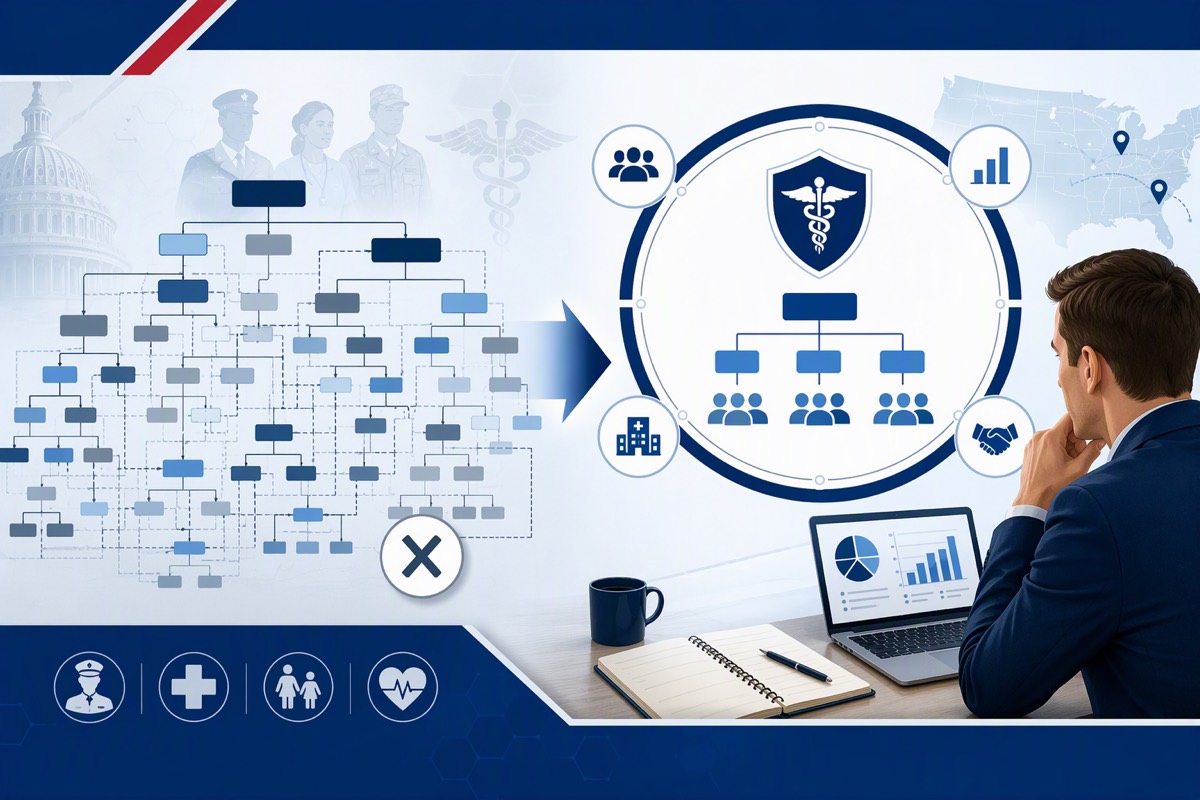
Illustration: AI-generated image by SeoSorted for defdex.io; an illustration, not a photograph.
An organization chart shows reporting relationships. It rarely identifies who controls funding, writes requirements, evaluates technology or selects the acquisition route. Map six roles before capture begins:
- Mission owner: defines outcomes.
- Program office: establishes whether demand has resources behind it.
- Funding organization: the source of money, often not the buyer.
- Contracting office: with the vehicle, determines how companies can compete.
- Technical evaluator: judges fit and risk.
- Operational user: reveals workflow and deployment constraints.
Mission owners and users do not necessarily control procurement. DHA may standardize architecture, cybersecurity or clinical processes while purchasing remains distributed across programs, networks, facilities and vehicles, so build relationships across mission, program, acquisition and operational teams rather than relying on one headquarters contact. The contracting offices table above shows where DHA awards are actually issued.
Budget and Spending Evidence
Budget documents, forecasts, transaction records and award notices answer different questions; no single source gives a complete market view. Separate requested funding, enacted funding, obligations, contract ceilings and task-order values. A ceiling is potential capacity, not realized revenue.
Use budget materials for mission direction, forecasts for expected acquisitions, and awards or modifications to confirm buying activity. Periods of performance, options and bridge actions help establish timing. Our guide to the Federal Procurement Data System explains how to turn procurement records into market intelligence.
Useful signals that a priority is funded and durable include recurring obligations, related task orders, exercised options, follow-on notices and continued support after deployment. Separate isolated pilots from repeat demand; a visible announcement matters less than a funded transition path.
Contract Vehicles, Task Orders and Recompete Signals
DHA requirements may use standalone contracts, indefinite-delivery vehicles, government-wide vehicles, blanket purchase agreements or task orders, and each route creates a different competitive field. Technical fit does not guarantee prime access; if a company lacks the required vehicle, partnering may be the stronger approach.
Building a recompete watchlist
| Field | Why it matters |
|---|---|
| Incumbent and award ID | Connects work to transaction history |
| Contracting office | Identifies the acquisition channel |
| Vehicle | Defines prime eligibility |
| Obligations | Shows funded activity |
| End dates and options | Clarify timing |
| Related notices | Reveal follow-on activity |
By the time a solicitation is released, vehicle selection, incumbent knowledge and prior engagement may have shaped the field. Validate ownership, monitor market research, assess vehicle access and identify teammates beforehand; the solicitation should confirm the strategy, not create it.
Where DHA Demand Is Concentrated
Organize demand around buying evidence, not generic priority lists. Discussion of a capability does not by itself establish funded demand.
- Digital health, EHR and interoperability: deployment, sustainment, integration, data exchange, analytics, training and support, which can have different owners and acquisition paths. Separate enterprise modernization from facility implementation and continuing operations.
- Cybersecurity, cloud and enterprise infrastructure: identity, hosting, networks, monitoring, compliance and incident support. Strategy documents give context, but awards show purchasing, and the visible user may not issue the contract.
- Virtual care, logistics and clinical support: acquired at enterprise, regional or local levels, which affects ownership, staffing, pricing and vehicle selection. For pilots, look for an acquisition owner, follow-on funding and a route to deployment.
Incumbents and Teaming Paths
Incumbent analysis must be account-specific: connect prime awards, funded orders, predecessor contracts, subcontract signals and partner announcements. Company-wide revenue does not prove strength on a particular recompete, and the contractor list above is a record of past awards, not a ranking of future advantage.
Real incumbent advantage can include active task orders, vehicle access, experienced staff, facility presence, operational knowledge and manageable transition risk. Test whether it fits the follow-on scope; a changed architecture, acquisition strategy or set-aside can reshape the field. Partner instead of prime when another company controls vehicle access, customer past performance or integration work, and settle workshare and mission value early.
Finding and Qualifying Opportunities Before Release
Combine notices, forecasts, award records, task orders, modifications, budget materials and agency communications. Searching only for "Defense Health Agency" can miss records tied to programs, offices, vehicles or other DoW entities, so track contracting offices, program names, contract numbers, incumbents, vehicles, places of performance, classification codes and predecessor awards. Funding agencies, buyers and users appear differently across systems, so entity resolution is essential.
Before committing resources, confirm:
- Mission customer and operational user
- Program, funding and acquisition owners
- Procurement path and vehicle access
- Obligations and expected timing
- Incumbent position and teaming needs
- Technical and transition risks
A large solicitation can still be a poor pursuit; a funded subcontract may be a more credible entry.
Entry paths for small businesses and startups
New vendors can consider prime bids, set-asides, subcontracts, vehicle partnerships, pilots and other authorized pathways. Innovation activity is not scalable demand without an acquisition owner and transition funding. Prime when access, past performance and delivery capacity align; partner when another company provides the vehicle or customer position; pilot when it can produce a credible mission outcome with a defined follow-on path. Before joining a team, clarify workshare, customer access, proposal roles, exclusivity, data rights, vehicle access and funding status.
Headquarters and Contacts
USAGov lists DHA's main address as 7700 Arlington Boulevard, Suite 5101, Falls Church, Virginia 22042-5101; check official sources before travel or correspondence. That address does not identify which office owns a requirement. Use forecast, sources-sought and solicitation contacts for acquisition questions, and official DHA and Military Health System pages for current locations, portals, patient services and jobs.
Contracting Offices1
| Name | Awards | Obligated |
|---|---|---|
| 3,269 | $73.9M |
Prime contract obligations since FY2008, largest first.