

Federal department · Code 097
U.S. Department of War
The Department of War is the cabinet department that provides the military forces to deter war and protect the country.
About
The Department of War is the cabinet department that provides the military forces to deter war and protect the country. The President is commander in chief, and the Secretary of War directs the department. It takes in the three military departments, the Joint Chiefs of Staff, the combatant commands, and agencies set up for particular defense jobs.
Identity and Data Scope
U.S. Department of War is listed as a federal department. No parent organization is recorded.
- Agency code
- 097
59,278,496 prime-contract and research-assistance actions are recorded for this body and its mapped subordinate agencies and offices. These total $7.19T obligated, including negative and zero actions. 48,589,382 awards are recorded. Contract data: Oct 6, 2026. Department of Defense contract data runs about 90 days earlier than DHS, DOE and NASA data because of DoD’s 90-day publication delay.
The baseline begins in FY2008. This body’s dollar totals include every recipient size; contractor and program breakdowns use the narrower published catalog. These are obligations on prime contracts and on assistance in the reviewed research programs, not budget authority, outlays or announced ceilings. Subcontracts are not included. Flood insurance, DHS disaster and other assistance outside the research allowlist, and non-research DoW, DOE and NASA assistance are left out of this total; the methodology reports each as a separate line. Program lists identify reported acquisition codes; an absent program link does not mean the body has no programs.
Verify identifiers and award records on USAspending; use the baseline and promotion rules to distinguish totals from the awards served individually.
Recorded obligations by fiscal year
| Fiscal year | Obligated (net) |
|---|---|
| FY2027 (partial) (provisional†) | $0 obligated |
| FY2026 (partial) (provisional†) | $380.52B obligated |
| FY2025 | $497.66B obligated |
| FY2024 | $452.50B obligated |
| FY2023 | $463.45B obligated |
| FY2022 | $421.22B obligated |
| FY2021 | $392.44B obligated |
| FY2020 | $428.46B obligated |
| FY2019 | $388.47B obligated |
| FY2018 | $363.46B obligated |
| FY2017 | $325.37B obligated |
| FY2016 | $302.31B obligated |
| FY2015 | $278.28B obligated |
| FY2014 | $288.41B obligated |
| FY2013 | $312.33B obligated |
| FY2012 | $367.42B obligated |
| FY2011 | $379.09B obligated |
| FY2010 | $372.30B obligated |
| FY2009 | $376.37B obligated |
| FY2008 | $400.46B obligated |
† Provisional: DoD reports contract actions to USAspending with a 90-day delay. DoD actions dated Jul 8, 2026 to Oct 6, 2026 (the data date) are largely missing. How this works.
Guide · by DefDex · reviewed
How do you find a real contract opportunity inside the Department of War?
The Department of War is not one customer, one budget or one acquisition system. Military departments, defense agencies, program offices and contracting organizations turn policy into funded requirements at different speeds. Trace authority, appropriations, acquisition pathway, obligations and incumbent position, and label each dollar requested, enacted, ceiling or obligated, rather than relying on topline budgets, speeches or award ceilings.
The operational user, requirements owner, resource sponsor, acquisition owner and contracting authority may be different organizations, so an account labeled only Department of Defense has little operational value.
Winning a place on a contract vehicle creates eligibility, not funded work; do not present vehicle access as traction.
Modifications can matter more than original awards: a small initial award can grow while a large announced ceiling stays largely unused.
A prototype or other transaction award does not guarantee production; the critical variable is transition, not publicity.
The guide's review date is separate from the contract data cutoff shown with the data.
News20
- Nov 24, 2026Government record (high significance)U.S. Department of WarContracts for Nov. 24, 2026
- Nov 24, 2026CompanyBy Light Professional IT ServicesBy Light Wins Prime Position on $400 Million NIWC Pacific Multiple Award Contract
- Nov 23, 2026Government record (high significance)U.S. Department of WarContracts for Nov. 23, 2026
- Nov 21, 2026NewsBreaking DefenseDespite Hegseth memo, Canada hasn’t seen changes to defense relationship with US, says DefMin
- Nov 21, 2026NewsBreaking DefenseSenate gearing up to investigate Ukraine’s access to Starshield
Military Departments3
| Name | Awards | Obligated |
|---|---|---|
 | 2,107,931 | $2.16T |
 | 2,081,623 | $2T |
 | 907,346 | $1.39T |
Prime contract obligations since FY2008, largest first.
Defense Agencies18 · 13 with contracts
| Name | Awards | Obligated |
|---|---|---|
 | 42,907,050 | $775.88B |
| 66,592 | $234.77B |
 | 14,414 | $143.20B |
 | 183,977 | $109.36B |
 | 98,394 | $38.06B |
 | 5,012 | $24.56B |
 | 7,588 | $19.73B |
| 2,125 | $6.97B |
| 26,189 | $6.01B |
 | 5,974 | $5.44B |
 | 199,540 | $1.99B |
 | 3,352 | $612M |
 | 207 | $113M |
 | 0 | $0 |
 | 0 | $0 |
 | 0 | $0 |
 | 0 | $0 |
Prime contract obligations since FY2008, largest first.
Intelligence Agencies4 · 3 with contracts
| Name | Awards | Obligated |
|---|---|---|
| 619 | $105M |
 | 218 | $85.8M |
 | 10 | $10.6M |
 | 0 | $0 |
Prime contract obligations since FY2008, largest first.
Combatant Commands12 · 5 with contracts
| Name | Awards | Obligated |
|---|---|---|
 | 63,060 | $86.15B |
 | 56,874 | $65.49B |
 | 470 | $960M |
 | 2,433 | $126M |
 | 1,322 | $49.9M |
 | 0 | $0 |
 | 0 | $0 |
 | 0 | $0 |
 | 0 | $0 |
 | 0 | $0 |
 | 0 | $0 |
Prime contract obligations since FY2008, largest first.
Field Activities7 · 5 with contracts
| Name | Awards | Obligated |
|---|---|---|
| 2,885 | $67.77B |
 | 20,775 | $35.33B |
| 3,164 | $17.37B |
 | 5,329 | $3.79B |
 | 7,855 | $1.94B |
| 0 | $0 |
 | 0 | $0 |
Prime contract obligations since FY2008, largest first.
Joint Schools2 · 1 with contracts
| Name | Awards | Obligated |
|---|---|---|
 | 7,982 | $4.08B |
 | 0 | $0 |
Prime contract obligations since FY2008, largest first.
Offices8 · 3 with contracts




Prime contract obligations since FY2008, largest first.
Other Sub-agencies2 · 0 with contracts
| Name | Awards | Obligated |
|---|---|---|
 | 0 | $0 |
 | 0 | $0 |
Prime contract obligations since FY2008, largest first.
Contracts and Research Assistance Awarded$7.19T obligated · as of Oct 6, 2026
- Obligated
- $7.19T
- Contract and research-assistance actions
- 59,278,496
- 48,589,382 awards
- Peak year
- FY2025
- $497.66B obligated
- Top contractor
- Lockheed Martin
- 22% of catalog obligations
Show as table
| Fiscal year | Obligated | Actions | Awards |
|---|---|---|---|
| FY2027 (to date) (provisional†) | $0 obligated (provisional†) · as of Oct 6, 2026 | 1 | — |
| FY2026 (to date) (provisional†) | $380.52B obligated (provisional†) · as of Oct 6, 2026 | 3,210,136 | — |
| FY2025 | $497.66B obligated · as of Oct 6, 2026 | 4,507,210 | — |
| FY2024 | $452.50B obligated · as of Oct 6, 2026 | 4,438,690 | — |
| FY2023 | $463.45B obligated · as of Oct 6, 2026 | 4,421,814 | — |
| FY2022 | $421.22B obligated · as of Oct 6, 2026 | 4,368,701 | — |
| FY2021 | $392.44B obligated · as of Oct 6, 2026 | 4,354,756 | — |
| FY2020 | $428.46B obligated · as of Oct 6, 2026 | 4,052,654 | — |
| FY2019 | $388.47B obligated · as of Oct 6, 2026 | 4,354,108 | — |
| FY2018 | $363.46B obligated · as of Oct 6, 2026 | 4,522,292 | — |
| FY2017 | $325.37B obligated · as of Oct 6, 2026 | 3,684,798 | — |
| FY2016 | $302.31B obligated · as of Oct 6, 2026 | 3,681,622 | — |
| FY2015 | $278.28B obligated · as of Oct 6, 2026 | 3,222,040 | — |
| FY2014 | $288.41B obligated · as of Oct 6, 2026 | 1,362,184 | — |
| FY2013 | $312.33B obligated · as of Oct 6, 2026 | 1,346,408 | — |
| FY2012 | $367.42B obligated · as of Oct 6, 2026 | 1,474,343 | — |
| FY2011 | $379.09B obligated · as of Oct 6, 2026 | 1,562,412 | — |
| FY2010 | $372.30B obligated · as of Oct 6, 2026 | 1,578,975 | — |
| FY2009 | $376.37B obligated · as of Oct 6, 2026 | 1,528,666 | — |
| FY2008 | $400.46B obligated · as of Oct 6, 2026 | 1,606,686 | — |
† Provisional: DoD reports contract actions to USAspending with a 90-day delay. DoD actions dated Jul 8, 2026 to Oct 6, 2026 (the data date) are largely missing. How this works.
Catalog awards
Prime contracts published for companies in the DefDex award catalog. The catalog total is $3.72T obligated through Oct 9, 2026.
Contractors
- Lockheed Martin$835.60B obligated 22%
- Boeing$409.71B obligated 11%
- RTX$403.05B obligated 11%
- General Dynamics$337.33B obligated 9.1%
- Northrop Grumman$228.16B obligated 6.1%
- HII$131.76B obligated 3.5%
- BAE Systems$127.25B obligated 3.4%
- L3Harris Technologies$75.30B obligated 2.0%
- Leidos$69.34B obligated 1.9%
- GE Aerospace$52.52B obligated 1.4%
- All other$643.71B obligated 17%
Companies, with their subsidiaries counted under the parent.
Defense programs
- F-35$298.73B obligated 8.0%
- MDA Support$108.14B obligated 2.9%
- SSN 774$87.54B obligated 2.4%
- Trident II Missile$44.88B obligated 1.2%
- DDG 51$43.12B obligated 1.2%
- P-8A$40.14B obligated 1.1%
- V-22$38.46B obligated 1.0%
- C-130J$37.92B obligated 1.0%
- KC-46A$36.85B obligated 1.0%
- CVN 78$30.50B obligated 0.8%
- All other$124.82B obligated 3.4%
Only awards coded to a DoW acquisition program.
What it buys (PSC)
- Aircraft, Fixed Wing$510.48B obligated 14%
- Combat Ships and Landing Vessels$244.54B obligated 6.6%
- Guided Missiles$183.36B obligated 4.9%
- Support- Professional: Engineering/Technical$182.91B obligated 4.9%
- Aircraft, Rotary Wing$116.83B obligated 3.1%
- Gas Turbines and Jet Engines, Aircraft, Prime Moving; and Components$104.44B obligated 2.8%
- Support- Management: Logistics Support$92.79B obligated 2.5%
- Miscellaneous Aircraft Accessories and Components$72.60B obligated 2.0%
- Maint/Repair/Rebuild of Equipment- Aircraft and Airframe Structural Components$59.92B obligated 1.6%
- Support- Professional: Other$54.17B obligated 1.5%
- Combat, Assault, and Tactical Vehicles, Tracked$51.75B obligated 1.4%
- Marine Lifesaving and Diving Equipment$49.20B obligated 1.3%
- Guided Missile Components$49.07B obligated 1.3%
- National Defense R&D SVCS; Department of Defense - Military; R&D Facilities & Maj Equip$47.44B obligated 1.3%
- Nuclear Reactors$47.01B obligated 1.3%
Obligations U.S. Department of War signed from USAspending, FY2008 through Oct 6, 2026, including de-obligations. The total and the yearly figures count every recipient, on federal prime contracts and on assistance in the reviewed research programs; other assistance is excluded. The catalog breakdown below uses its own total. Department of Defense contract data runs about 90 days earlier than DHS, DOE and NASA data because of DoD’s 90-day publication delay.
What the Department of War Does
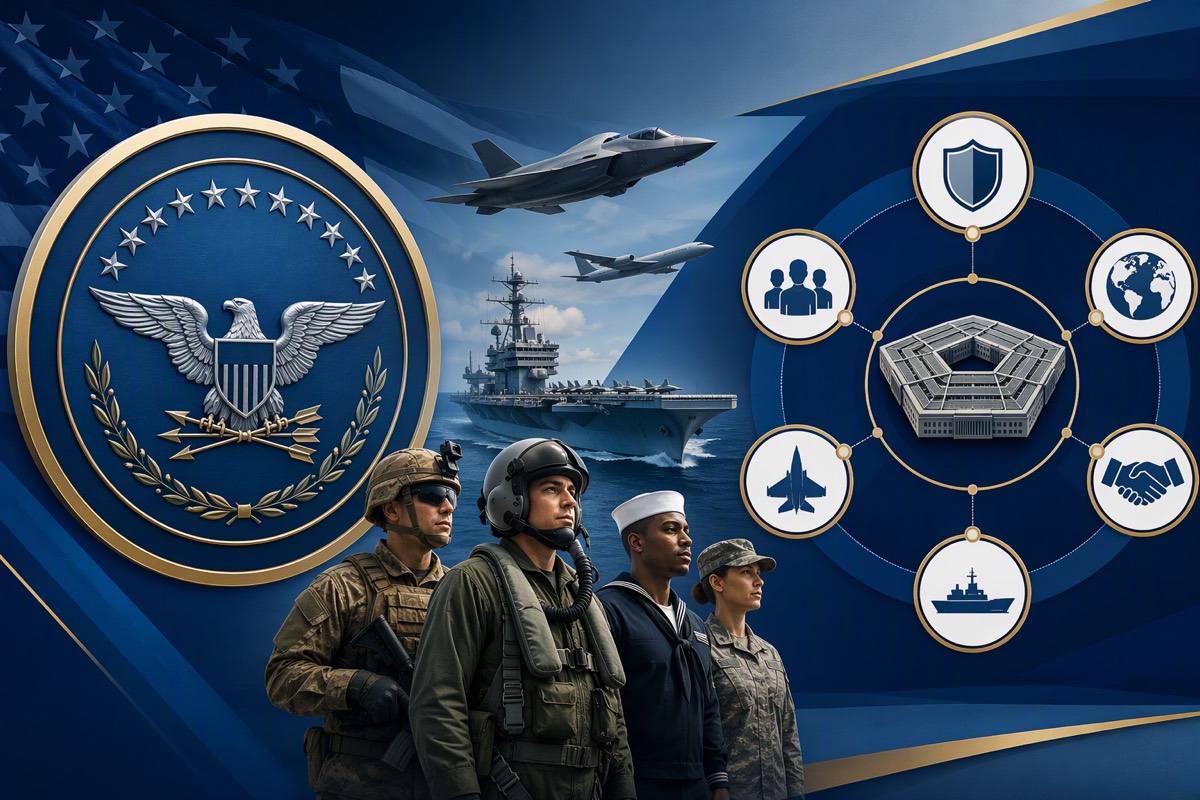
Illustration: AI-generated image by SeoSorted for defdex.io; an illustration, not a photograph.
The U.S. Department of War (DoW) provides the military forces needed to deter war and protect the security of the United States, as described by USAGov. That statement does not explain how the institution creates opportunities for suppliers, contractors and investors. The contract data above shows where obligations have landed; this guide explains how a policy priority becomes funded work and how to read the evidence along the way.
A policy priority is not yet a market. It becomes commercially meaningful when the government assigns responsibility, establishes a requirement, secures usable funding and selects a way to buy. The process runs through strategy, force planning, congressional action, program offices, contracting organizations and individual transactions. The department extends well beyond the Pentagon building: military departments, armed services, defense agencies, operational commands and supporting organizations at home and overseas play different roles. Some set policy, some develop requirements, some manage programs, some contract, and others operate systems or create demand through missions. An office can influence a market without issuing a contract, so a company that watches only the contracting office may enter too late, while one that follows only senior statements may mistake early interest for demand.
Policy, requirements and procurement are different signals
Speeches, strategies, directives, budget materials, solicitations and contract announcements are not equal evidence of demand. Classify them by function:
- Policy signals: what leaders want prioritized.
- Requirements signals: what users and acquisition organizations need.
- Budget signals: whether resources have been requested or made available.
- Procurement signals: how the government plans to buy.
- Obligation signals: funding has been legally committed.
- Performance signals: whether suppliers are delivering and work may continue.
A speech can move attention; a funded contract moves money. The strongest thesis connects the policy rationale, responsible organization, budget line, acquisition pathway, likely vehicle, incumbents and current obligations. Official directories help find a website or contact channel but do not show program ownership or supplier concentration; the hard part is connecting separate records into a defensible market map.
Core questions for market analysis
- What military problem is the department trying to solve?
- Which organization owns the mission or requirement, and which office controls or influences the program?
- What type of funding may support the work, and has it been made available?
- Is the opportunity tied to an established program?
- Which acquisition method and vehicle are likely?
- Who are the incumbents, teammates or qualified alternatives?
- How much has been obligated?
- What evidence suggests the work will scale, continue or transition?
These prevent a common error: confusing the size of the Department of War with the size of a specific, accessible market.
Why the Pentagon Is Not One Customer
Buying decisions are distributed across organizations with different operational needs, budgets, technical standards and acquisition practices, so "selling to the DoW" is too broad to guide a strategy. Enterprise software does not follow the same buying path as a weapons subsystem, logistics service, intelligence capability or field experiment, and even similar technologies face different security architecture, integration and sustainment requirements. Define a market below the "DoW" level: a military service, defense agency, program executive office, program or product office, mission portfolio, contracting command, installation or operational community, vehicle and its eligible ordering organizations, or a technology problem shared by several buyers. The sub-agency and department directories help move from the department to the office that owns the mission, funding, program or contract.
The user, buyer and payer may be different organizations
An operational user feels the problem, a requirements organization formalizes it, a resource sponsor protects funding, a program office manages acquisition and a contracting officer executes the purchase. A capability can have strong user support but no acquisition sponsor, a funded program but integration resistance, or an experimental award without a path to wider deployment. Map at least five roles:
| Role | Central question |
|---|---|
| Operational user | Who needs the capability in practice? |
| Requirements owner | Who validates and formalizes the need? |
| Resource sponsor | Who argues for and protects funding? |
| Acquisition owner | Who manages the program or procurement? |
| Contracting authority | Who can execute the contract? |
A technical gatekeeper (cybersecurity, architecture, testing, airworthiness, spectrum access) may also matter. Influence crosses formal boundaries: a policy office sets direction, a service acquisition organization controls implementation, an operational command creates urgency, Congress shapes funding, and an incumbent may hold the integration position a new component needs. Treat organization charts as a starting point.
Opportunity ownership can change
A requirement may move between organizations as it matures: early experimentation in a laboratory, innovation organization or operational unit, later transition to a program office. Experimental sponsorship shows interest; program ownership may create a path to repeatable procurement, integration and sustainment. A renamed office without new resources may be largely administrative, while one with delegated authority and funding can change the market.
Practical implications
Contractors should build account plans around buyer systems: which office owns the requirement, which can fund it, which can buy it, which vehicles could support the purchase, the expected competitive approach, who already has customer access or integration responsibility, which certifications, clearances or facilities create entry barriers, and when requirements and budgets are most open to industry input. A target labeled only "Department of War" describes an institution, not a qualified opportunity.
Investors should not treat defense exposure as a simple share of federal revenue. Quality depends on funding durability, program maturity, contract type, remaining performance or ordering period, funded backlog, customer concentration, production capacity, recompete timing, incumbent position, subcontractor dependence, transition risk and exposure to temporary funding constraints. Two companies may announce similar headline awards while one holds a funded production order and the other is only eligible to compete for orders under a shared ceiling.
How the Department Is Organized
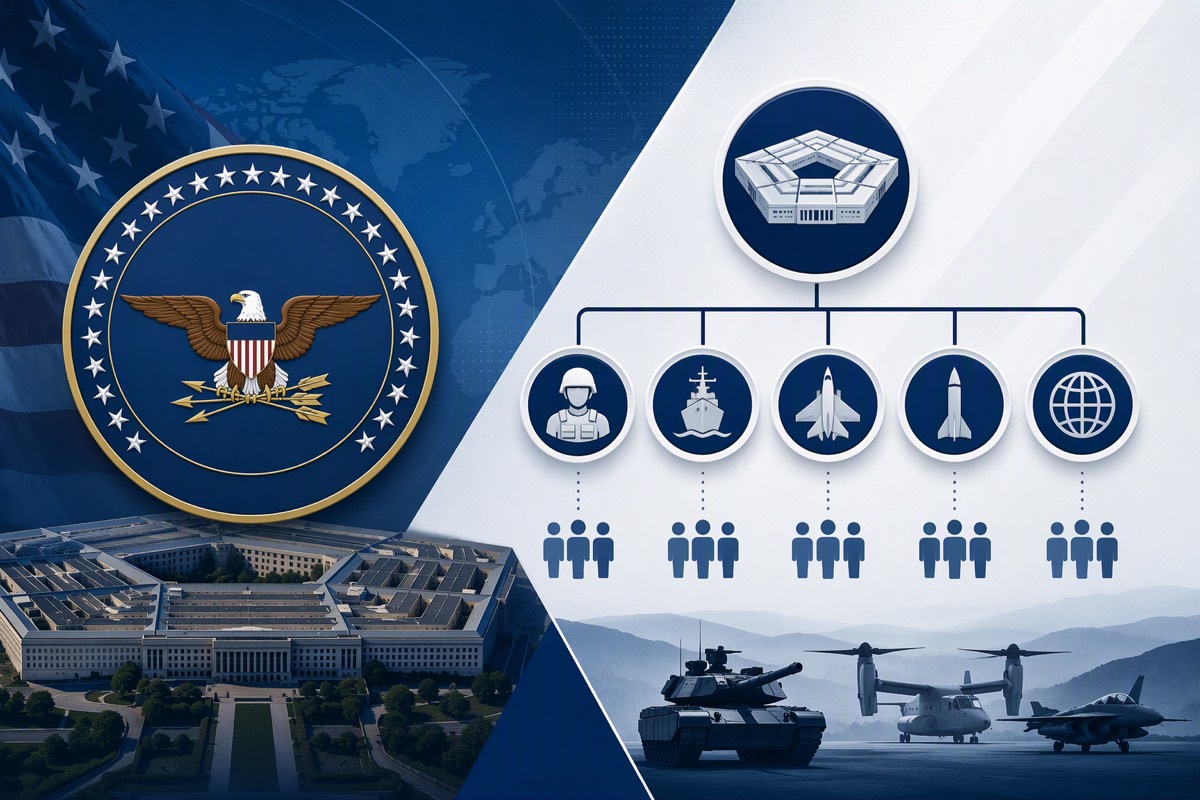
Illustration: AI-generated image by SeoSorted for defdex.io; an illustration, not a photograph.
DoW operates through civilian and military structures: department-level leadership, military departments, joint organizations, operational commands, defense agencies and supporting activities. The goal is not to memorize every box but to see what decisions each part can influence or execute.
- Office of the Secretary of War: department-level policy, oversight and management covering acquisition policy, research, force development and industrial capacity. A department-level priority is a directional signal, not the ultimate buyer; trace it down to the offices that receive assignments, funding and acquisition responsibility. Evidence of implementation includes directives or memoranda, assigned executive responsibility, budget materials, reprogramming actions, new acquisition organizations, solicitations or transaction notices, obligations and production or fielding decisions.
- Military departments and services: organize, train and equip forces. Senior leaders set direction, but program executive offices and program managers usually control the opportunities most relevant to suppliers. Distinguish departmental and service headquarters, acquisition executives, program executive offices, program managers, systems commands, laboratories, contracting commands and operational units. A research concept may fit a laboratory; a production-ready subsystem needs a program office and often a prime; a commercial software product needs a mission owner, a security path and an available vehicle.
- Defense agencies and supporting activities: provide functions used across the department, such as logistics, information systems, contracting, finance and technical services, and can control markets that fit no single service. The label still covers too much for detailed work; see, for example, the pages for the Defense Logistics Agency, Defense Health Agency, Missile Defense Agency, DARPA and the National Security Agency, and the sub-agencies list above.
- Combatant commands: identify mission needs and employ forces but do not necessarily own the acquisition programs that provide enduring capability. A command may validate urgency and support experimentation while a military department or agency manages procurement. A credible pathway links operational demand to a validated requirement, a sponsoring service or agency, identified funding, an acquisition owner and a deployment and sustainment plan.
- Joint organizations: can influence needs that span services, but a joint requirement is not a joint procurement. The first concerns what several parts of the force need; the second asks whether buying authority and funding are actually consolidated.
- Program offices: a commercial center of gravity that decide what gets integrated, tested, produced and sustained. A useful program-office map includes parent organization, program executive office and manager, product offices, responsibilities, budget lines, active vehicles, primes and major subcontractors, planned solicitations, recompete dates and testing organizations. It also shows where a supplier should partner rather than compete.
- Contracting organizations: contracting officers execute procurement within their authority and manage solicitations, negotiations, awards and administration, but often do not originate the need. A contracting office is the wrong audience for developing an unfunded requirement, and mission advocacy without contracting awareness can yield a requirement with no executable purchasing path.
How Defense Funding Flows
A topline budget is a poor standalone measure of opportunity. It communicates scale and political direction but not which organizations can spend, when funding becomes available or which suppliers may receive it. Budget requests, enacted funding, obligations and outlays describe different stages, and blurring them overstates demand. For the current-year detail see US Defense Budget: How to Read FY2026 Funding Without Double Counting.
- Requested: the president's budget request is the administration's proposal and shows priorities, planned programs, quantities and funding categories. It does not make amounts available; Congress can add, reduce, redirect or restrict. A request is forward-looking evidence, not booked revenue. Use it to spot emerging priorities, proposed program starts, planned increases or cuts, research-to-procurement transitions, quantity changes and organizational responsibility, then monitor congressional action and execution.
- Authorized and enacted: authorization legislation establishes or continues programs and gives policy direction, while appropriations provide budget authority subject to statutory terms. A program can get supportive authorization language without the expected appropriation, and funds may carry conditions. Track both; see the National Defense Authorization Act guide.
- Funding categories: research, procurement, operations, personnel and construction support different activities, with different availability and conditions. A company on an experimental research effort has a different revenue profile from one receiving recurring production orders, even under the same strategic priority.
- Reprogramming: leadership can shift priorities after enactment by moving resources within legal limits. It can show where activity is being accelerated or protected, and signal pressure elsewhere, so do not assume the enacted picture is unchanged through execution.
- Obligated and outlays: an obligation is a legal commitment, such as through a contract or order, and generally evidences realized demand better than an announced ceiling. Outlays are payments, which follow performance and invoicing and may lag. A program may have available funding but slow obligations, and a contractor may hold funded orders while recognizing revenue by delivery schedule and accounting policy; government spending records and company financials need separate interpretation.
- Temporary funding: continuing resolutions can constrain new starts, expanded quantities or planned awards while existing work continues. Ask whether the target program depends on a new start, increased quantity or changed scope.
Higher spending can expand demand without distributing it broadly. Where production capacity, qualified suppliers, integration complexity or security requirements constrain the market, incumbents with vehicles, cleared people or facilities, approved processes, interface access, past performance, established supply chains and integration or sustainment responsibility capture most of it. A supplier's position within a funded program matters more than its rhetorical alignment with a national priority.
A practical funding funnel
- Strategic priority: leadership identifies a problem.
- Programmatic response: an organization receives responsibility.
- Budget request: funding is proposed (requested).
- Congressional action: funding and policy are enacted (enacted).
- Execution plan: the organization decides how to use available resources.
- Procurement action: a solicitation, transaction or order is issued.
- Obligation: funding is committed to a recipient (obligated).
- Performance: the contractor delivers.
- Outlay: the government pays.
- Follow-on: the effort continues, expands, recompetes or ends.
The addressable opportunity narrows at each stage, and forecasts should reflect that attrition.
How Acquisition Turns Requirements into Contracts
Acquisition has no single path; the route depends on product, mission, maturity, urgency, funding and legal authority. Traditional procurement, commercial acquisition, research agreements and other transaction pathways each have different implications for competition, intellectual property, scale and follow-on potential.
Requirements before durable procurement. A user can want a product without a durable, funded requirement; demonstrations and pilots occupy that gap. A durable requirement answers what problem is solved, who validates the need, what performance is required, how the capability integrates, who funds procurement and sustainment, what happens after the first test and who accepts deployment risk. Without answers, the opportunity is exploratory rather than scalable.
Established programs provide structure, not certainty. They give visibility into requirements, budgets and responsibility, but can be restructured, delayed, reduced or cancelled, and can be hard for new entrants to penetrate because they rely on existing architectures, primes, approved vendors and test processes. The accessible opportunity may sit at the component or subcontract level.
Contract vehicles shape access. A vehicle determines who may compete or receive work, and winning a place on it creates eligibility, not funded work. Keep separate the vehicle ceiling, individual contract ceiling, task or delivery order value, obligated amount, potential option value, remaining ordering period and revenue from funded work, so access is not presented as traction. A vehicle can still be strategically valuable by simplifying a customer's purchasing, but its economic value depends on demand, competition and actual orders.
Other transactions. OTAs may be used for research, prototypes or related work under applicable authority and offer flexibility for nontraditional suppliers and consortia. A prototype can validate technology and build a relationship but does not guarantee production. Ask whether the recipient is a prime, subcontractor or consortium member, what amount is actually obligated to the company, what milestone must be met, who owns the transition plan, whether a follow-on and production funding are identified, and whether integration and sustainment are addressed. The critical variable is transition, not publicity.
Innovation programs do not remove incumbent advantages. Incumbents may control integration environments, vehicles, secure infrastructure and customer relationships and absorb long timelines better. Newer suppliers struggle with security requirements, authorization to operate, data rights, accounting and compliance, contract terms, long sales cycles, production capacity, integration dependencies, program protection and sustainment obligations. For some, partnership is more practical than displacement.
Prototypes and production are separate markets. A demonstration shows a capability works in a defined setting; production needs repeatability, funding, deployment capacity, training, maintenance and support. A maturity ladder runs from customer discovery, unfunded evaluation, funded study, prototype award, operational demonstration and follow-on prototype to initial production or deployment, recurring orders, program integration, and sustainment and upgrades. A startup with several pilots may still trail a supplier with one smaller recurring production order.
Acquisition forecasts are useful but incomplete. Forecasts indicate planned competitions, timing and responsible organizations, but requirements can be delayed, combined, cancelled or moved. Confidence rises when a forecast aligns with a funded requirement, an incumbent contract nearing expiration, a published acquisition plan, industry engagement, a draft or final solicitation, named program ownership and stable budget support. No single procurement calendar is definitive.
How to Evaluate Contract Awards
A contract announcement is the beginning of analysis. Award notices may state large maximum values that reveal little about immediate funding or likely revenue, so start with contract structure and obligations.
Ceiling value is not funded value
A ceiling is the maximum that may be ordered under defined terms, not an amount the government has committed. This matters most for indefinite-delivery and multiple-award contracts, where a ceiling may be shared, competed over years and never fully used. Separate the maximum ceiling, initial obligation, stated minimum, number of awardees, ordering and option periods, estimated completion, funding source, customer organizations, competitive method and scope. If only the ceiling is known, the company's exposure is uncertain.
Initial obligations and the obligation timeline
The amount obligated at award is what the government has committed at that point. It is not recognized contractor revenue but is usually firmer evidence of traction than potential value. Further obligations may follow through modifications, task orders, exercised options or incremental funding, so track the contract over time: whether work is scaling, funding is episodic or recurring, options are exercised, momentum is fading, more organizations are ordering and the supplier converts access into funded demand.
Competition, prime and subcontract positions, and modifications
The same obligation means different things depending on how it was won. A competitive award may validate price and technical merit; a sole-source award may reflect unique capability, urgency, intellectual property or incumbency and needs review; a task order under an established vehicle shows customer traction without showing the company beat the open market. Prime contractors hold the direct relationship with the government; subcontractors depend on workshare, program performance and the prime's position, with risks including limited visibility, dependence on the prime's schedule and funding, workshare changes, margin pressure and replacement risk. The relevant question is where a company sits in the contractual and technical chain.
Modifications can matter more than original awards: they add funding, change scope, exercise options or adjust delivery. A small initial award can grow through repeated modifications while a large announced ceiling stays largely unused. Track cumulative obligations and scope changes at the contract level as a time series rather than a collection of press releases.
Contract type changes risk allocation
Fixed-price structures place more cost risk on the supplier, cost-reimbursement structures are used where uncertainty is greater, and other arrangements add incentives or time-and-materials elements. The label alone does not determine attractiveness; consider technical uncertainty, inflation and material exposure, production maturity, schedule, government-furnished inputs, change-order behavior, fee structure and working-capital needs. Revenue quality depends on execution conditions, not just award size.
A contract-award scorecard
| Dimension | Questions |
|---|---|
| Funding | How much was obligated, and what supports the funding? |
| Access | Is this a direct award, vehicle position, task order or subcontract? |
| Competition | How many companies can pursue the work? |
| Duration | What is funded now, and what depends on options? |
| Customer | Which program office or organization owns the requirement? |
| Maturity | Is the work research, prototype, production or sustainment? |
| Scale | Can the supplier deliver at the required volume? |
| Transition | Is there an identified route to follow-on work? |
| Incumbency | Does the award displace an incumbent or extend one? |
| Strategic fit | Is the contract central to the mission or peripheral? |
For turning raw contract records into evidence, see Federal Procurement Data System: From Contract Records to Defense Market Intelligence.
Tracking Priorities, Incumbents and Emerging Suppliers
A priority may appear first in a speech, then a strategy, budget exhibit, solicitation and contract action. Speed helps, but evidentiary discipline matters more.
Build an evidence chain
Speeches, interviews and messaging reveal leadership emphasis that can change. More durable evidence includes published strategy, formal directives, assigned responsibility, budget exhibits, congressional action, reprogramming, acquisition strategies, requests for information, draft and final solicitations, obligations, and production or fielding activity. The closer a signal is to an obligation and deployment, the stronger its commercial relevance. Strategy matters commercially when it can be tied to portfolios, buyers and funded execution; see National Defense Strategy: A Market Guide to the 2026 Shift.
Narrative momentum (leaders repeatedly discussing a technology or reform) and financial momentum (funding and acquisition directed toward it) can align, often with a lag. Compare the frequency and seniority of policy references, presence in strategy documents, changes in requested funding, enacted support, funded acquisition activity, entry into enduring programs and production quantities. Strong attention with weak obligations may mean the theme is emerging, blocked or overstated; less attention with rising obligations may be the stronger near-term opportunity.
Map incumbents at the program level
Company-level defense revenue cannot reliably show supplier concentration, because large contractors participate in many unrelated markets and specialists may hold strong positions in narrow areas. Map incumbency through prime contracts, task and delivery orders, major subcontract roles, platform integration responsibilities, modifications, sustainment positions, follow-on awards, facilities and capacity, vehicle access and technical ownership or data rights, to find who controls customer access, integration points or bottlenecks. It also reveals partnership routes: a startup may enter as a subsystem, software module or specialized service without displacing a platform prime.
Measure startups by funded progression
Startup coverage emphasizes venture funding, backgrounds, demonstrations and innovation awards, which do not prove adoption at scale. Look for the first direct government obligation, repeat awards from one customer, expansion to other DoW organizations, movement from research to prototype, follow-on production, inclusion in an enduring program, recurring delivery orders, prime integration, deployment, and sustainment revenue. Repeat obligations usually weigh more than unrelated pilot announcements.
Leadership, time series and confidence levels
A personnel change alone is not a market shift. Assess leadership impact by the authority the leader holds, consistency of stated priorities, whether formal directives followed, whether responsibility moved, whether funding decisions changed, whether solicitations or obligations reflect it and whether incumbents are gaining or losing position. Keep a time series (proposed, funded, delayed, awarded, modified, expanded) rather than a news feed.
Grade opportunities by evidence:
- Low confidence: public comments without assigned ownership, unfunded demonstrations, broad requests for information, proposed funding without clear support, unverified company claims.
- Moderate confidence: named program responsibility, recurring budget requests, procurement forecasts, draft solicitations, existing vehicle access, prior obligations in the mission area.
- Higher confidence: enacted funding, a final solicitation, active competition, a funded task or delivery order, repeated obligations, exercised options, production or deployment activity.
Higher confidence is not guaranteed revenue; it means more concrete evidence. Also record negative signals even when they contradict a preferred thesis: requested reductions, congressional denial or restriction, repeated solicitation delays, scope consolidation favoring incumbents, program transfer without funding, test failures, production bottlenecks, unexercised options, falling obligations, turnover in the sponsoring office, and prototype completion without a transition sponsor.
Department of War Naming and Pentagon Announcements
Political branding can be consequential but does not by itself establish a change in legal authority, organizational responsibility or procurement behavior. As of this review (October 20, 2026): a September 2025 executive order made "Department of War" a secondary title for the Department of War, but reporting indicates the legal name set by Congress is unchanged unless Congress acts; in June 2026 the House and Senate armed services committees advanced fiscal 2027 NDAA text that would rename the department (Military Times, June 11, 2026). We have not confirmed whether that provision was enacted, so check the enacted NDAA text. This page keeps one stable URL and covers the same organization under either name; do not infer from a display name which name applied to a historical transaction. For how names appear across public channels, see Department of War Front Doors.
Terminology and authority are different questions. A legal name, public brand, social-media title and political phrase can differ, and a channel rename does not change appropriations, contracts, regulations or delegated authorities. Look for controlling documentation: enacted legislation, formal executive action, department directives, acquisition-regulation changes, appropriations language, contracting-system changes and delegation documents. Official channels are useful for monitoring messaging but are not substitutes for legislation, directives, solicitations, budget documents or signed contract actions.
Test any "announced today" item for exact publication date, issuing organization, signing official, document type, whether it is proposed or effective, affected organizations, funding implications, implementation timeline and the supporting directive, budget item or contract action. Then apply four questions to any press release: Authority (who issued it and what authority they hold), Resources (is funding available, requested or unidentified), Execution (which organization must implement) and Evidence (what later document or obligation would confirm progress). If these cannot be answered, keep it as a monitoring item, not a revenue forecast.
Strategic language can outpace acquisition: the Pentagon can change emphasis faster than it restructures programs, contracts and industrial capacity, and existing obligations continue because fielded systems still need support. Use both a forward-looking and an installed-base view. When sources conflict, weigh legislation and formal legal instruments for identity and authority, appropriations and official budget documents for funding, solicitations, award records, orders and signed modifications for procurement, and formal directives for organizational responsibility. Speeches and media are messaging, not execution.